
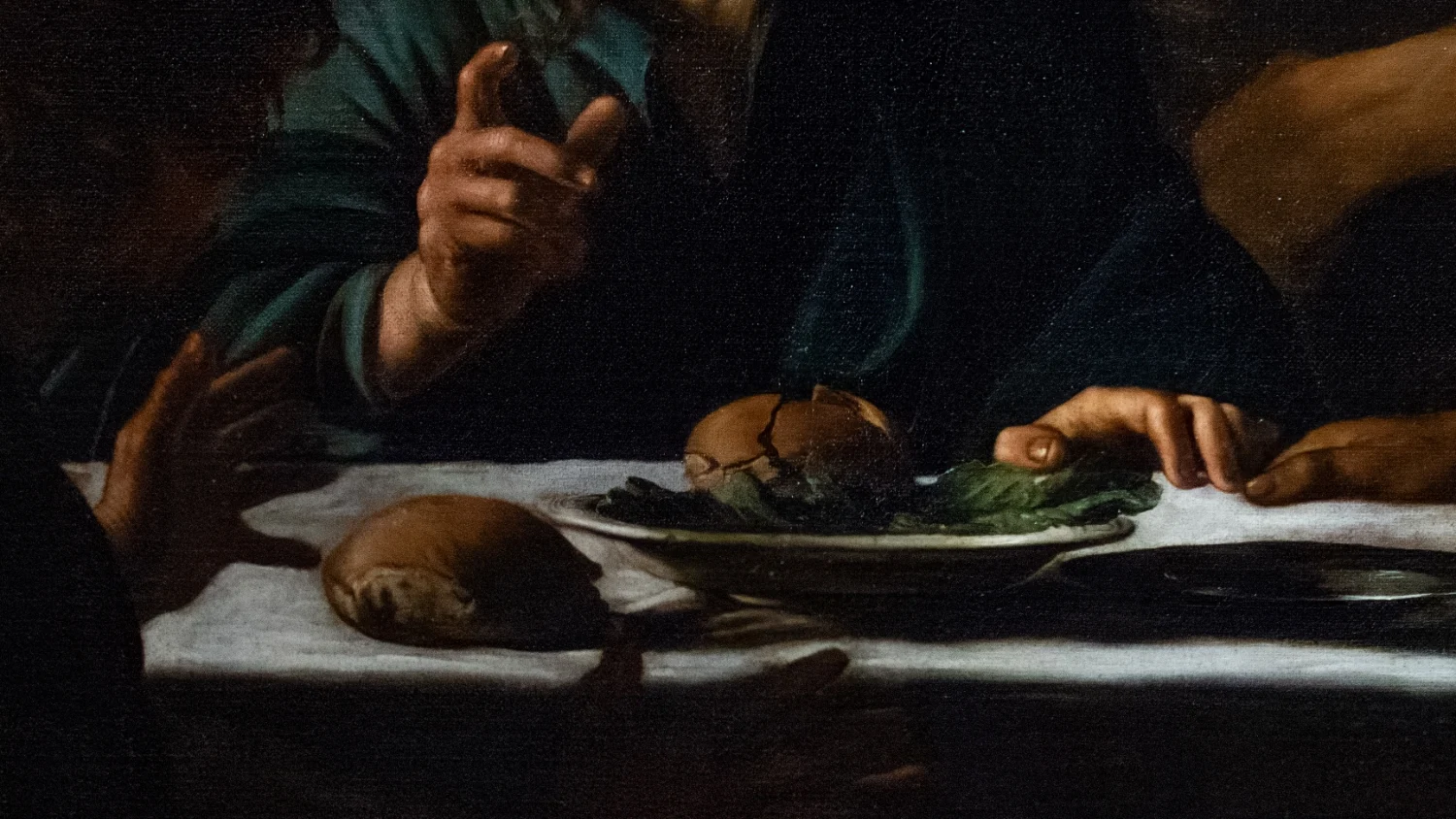
Bread, a staple food in the Mediterranean diet, has taken on a significance over the centuries that goes beyond mere nutrition. In art, bread is often represented as a symbol of life, sharing and spirituality.
An emblematic example of bread's symbolism is found in Caravaggio's The Supper at Emmaus, in which the gesture of breaking bread becomes a revelation and manifestation of the divine.
The episode of The Supper in Emmaus is narrated in the Gospel of Luke (24:13-35). Two disciples, Cleopas and another unnamed, are walking towards the village of Emmaus, discussing the recent events surrounding the death of Jesus. A wayfarer joins them and, along the way, explains the scriptures concerning the Messiah. Upon reaching their destination, the disciples invite the man to dine with them. It is at the moment when the wayfarer breaks the bread that their eyes are opened and they recognise in him the risen Christ, who immediately disappears from their sight.
This episode underlines the importance of the gesture of breaking bread as a moment of revelation and recognition of the divine. The bread thus becomes a symbol of Christ's presence and of the communion between believers.
Michelangelo Merisi da Caravaggio painted two versions of The Supper at Emmaus: the first in 1601, preserved in the National Gallery in London, and the second in 1606, now in the Pinacoteca di Brera in Milan. Both works depict the moment when the disciples recognise Jesus in the act of breaking bread.
The 1601 version: dynamic and theatrical

In the 1601 version, Caravaggio depicts a dynamic and theatrical scene. The disciples react with astonishment: one rises abruptly from his chair, while the other spreads his arms in a gesture that recalls the cross. Jesus is in the centre, at the moment of the blessing of the bread, in a gesture reminiscent of the Eucharist. The intense light illuminates the characters, creating a strong contrast with the dark background, typical of Caravaggio's chiaroscuro.
Realistic details can be seen on the laid table: a basket of fruit, a roast chicken, bread and wine. The fruit, in particular, shows signs of ripening and decay, symbols of the transience of life and resurrection. Some scholars have noted that the shadow cast by the basket forms the figure of Ichthys, the stylised fish symbol of the early Christians.
The 1606 version: intimate and reflective
The second version, painted in 1606, presents a more intimate and reflective atmosphere. The disciples' gestures are more restrained, and the scene is bathed in a more subdued light. The table is less richly laid, with only bread and wine, emphasising the essentiality of the Eucharistic gesture. This version probably reflects the difficult period experienced by Caravaggio, fleeing Rome after the murder of Ranuccio Tomassoni.

In the Christian tradition, bread is loaded with symbolic meanings. It is the body of Christ in the Eucharist, a symbol of spiritual nourishment and communion among the faithful. In art, bread also represents humility and sharing.
In both versions of The Supper at Emmaus, bread is at the centre of the scene, not only physically but also symbolically. It is through the gesture of breaking bread that the disciples recognise Jesus, underlining the importance of bread as a vehicle of divine revelation. Caravaggio is known for his stark and detailed realism. In The Supper at Emmaus, every element is depicted with precision: the expressions of the characters, the details of the clothing, the food on the table. This realism serves to bring the scene closer to the viewer, involving them emotionally and spiritually.
The bread, in particular, is painted with such accuracy that we can reach out and touch it. This helps emphasise its symbolic meaning and its importance in the scene.
Caravaggio's The Supper at Emmaus is a masterpiece that combines art, spirituality and symbolism. Bread, a simple, everyday element, becomes a vehicle of revelation and communion. Through his realism and his mastery in the use of light, Caravaggio manages to transform an ordinary gesture into a moment of profound spiritual significance.