
The Europeana platform provides multilingual access to over 60 million digitised cultural heritage items and their metadata, including texts, images, audiovisual material and 3D media. These items are aggregated from thousands of museums, libraries, galleries and archives across Europe.
Europeana for Academia and Research
The digital transformation of Europe's cultural heritage institutions makes valuable resources accessible for research, teaching and learning purposes. We connect academia with these institutions, support collaborative research, foster innovative teaching methods, and promote engagement with heritage.
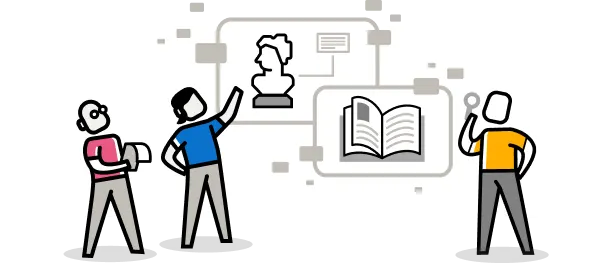
Access digital cultural heritage
Access cultural heritage data, metadata and datasets aggregated by Europeana on Europeana.eu and via our APIs.

Our APIs and how they work together
Our APIs allow you to access the cultural heritage items and their metadata in the Europeana collections, download datasets, and more. To use one of the APIs, request a free API key, and then read the documentation on how you can use it.

SPARQL API
Use the SPARQL QUERY language to interact with Europeana's database, and to explore connections with the outside sources.

Dataset download
Other methods for downloading and harvesting datasets and metadata, such as OAI-PMH, for extracting large amounts of data.

IIIF APIs
The IIIF APIs provide access to structured metadata about objects, and offer ways to visualise 2D objects in an interoperable viewer.
Resources on other platforms
Find Europeana aggregated datasets, training resources and tools below.

CLARIN Newspaper Corpora
A discovery portal which pools and contextualises resources for Social Sciences and Humanities research communities: tools, services, training materials, datasets, publications and workflows. Discover the dataset.
CLARIN Virtual Language Observatory
A web-based search and discovery platform for language resources, tools, and services collected by the CLARIN research infrastructure. Discover the CLARIN Virtual Language Observatory.

DARIAH
The DARIAH-Campus Resources page contains many useful resources, including the courses Introduction to Europeana APIs and Introduction to Cultural Heritage Data Modelling - with a focus on the Europeana Data Model.

European Open Science Cloud
An environment for hosting and processing research data to support EU science. The Resource Hub is an integrated platform that allows access to resources for various research domains along with integrated data analytics tools.
Europeana on Zenodo
The portal where digital cultural heritage research publications related to the Europeana initiative are posted, including relevant datasets. Discover the datasets.
Data.europa.eu
The official portal for European data, managed by the EU Publications Office, aggregates metadata from public sector information across Europe. Europeana's metadata and APIs are also available on data.europa.eu. Discover the datasets.
Partnerships and collaborations
Research infrastructures play an essential role in our ecosystem.

The Digital Research Infrastructure for Arts and Humanities supports digitally-enabled research and teaching.

Provides access to multimodal digital language data and tools with which to explore, analyse or combine these datasets.

A platform for hosting and processing research data to support EU science.

The SSHOC Cluster brings together 20 research organisations that play a key role in Social Sciences and Humanities.
Collections as Data
Advances in technology such as artificial intelligence and machine learning have provided a new context in which Collections as Data can be analysed using computational methods.

The workflow
A step by step guide for cultural heritage institutions for publishing their collections so that they are suitable for computational use.
The article
The accompanying article A Workflow to Publish Collections as Data provides additional context for the concept.

The course
Find the DARIAH-Campus resource introduction to Collections as Data to learn how to publish them.
Join the Research Community
A community engaged with cultural heritage as both a subject and research source, advocating for Open Science in the Humanities. Members work across cultural institutions, universities, government, and the private sector.
Why join?
- Benefit from our communication channels to keep informed, build up your professional network and promote your activities.
- Raise your international profile by connecting with peers at Europeana events or in relevant research contexts.
- Build collaborations and partnerships in the form of projects, task forces and working groups.
Click the button below to join the community through the Europeana Network Association. For any enquiries, contact Alba Irollo at alba.irollo@europeana.eu.
News
Read important news about digital cultural heritage research.

Describe digital cultural heritage datasets more effectively and supports both human- and machine-readable workflows.

Europeana Research has been investigating how digital cultural heritage is emerging in university education.

Discover more about the project and the steps it took to create musical (linked) data across existing collections.

His work focused on researching the integration of digital cultural heritage in higher education