
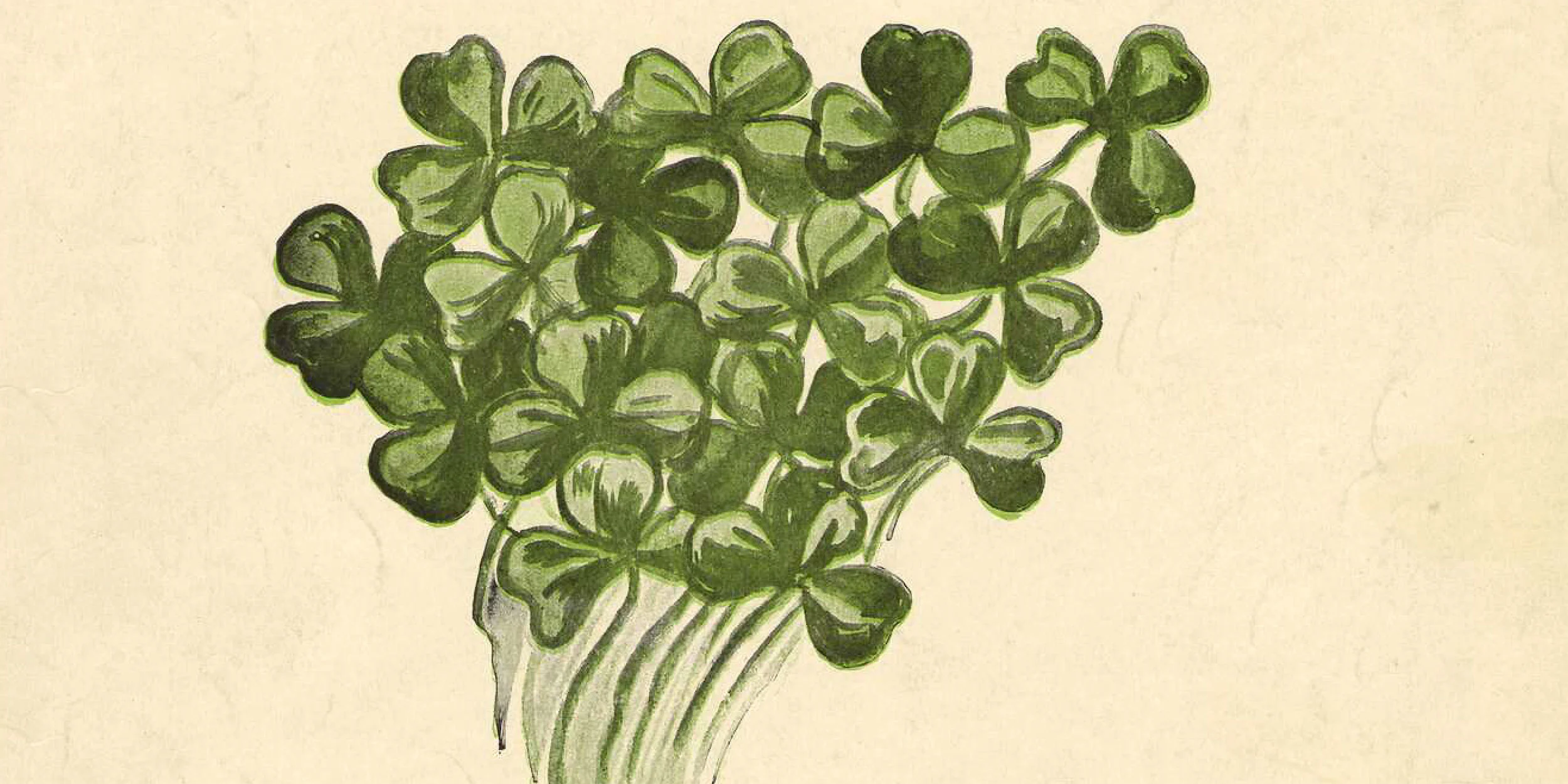
Every year, on 17 March, Irish communities around the world celebrate Saint Patrick's Day, or the feast of Saint Patrick. As Saint Patrick is the patron saint of Ireland, the day is an important cultural and religious celebration in cultural calendar of Ireland.
To celebrate, we’ve explored the history of the holiday and some of the Irish artefacts you can find in our collections.

Festivities include big parades, ceilidhs, and the wearing of green clothes and shamrocks, or sprigs of clover.
Saint Patrick is believed to have used shamrock to represent the Holy Trinity when he brought Christianity to the country, so the plant has a special status and is strongly associated with luck.
In this woodcut, you can see why Saint Patrick is considered to be the heroic protector of Ireland. The illustration retells the legend of how he drove all the snakes out of Ireland, and saved the Irish people from a plague of reptiles and demons.

In this sketch, a woman distributes shamrocks to wounded Irish soldiers on a busy hospital ward during the Boer War. It was published in 1900, the same year that Queen Victoria authorised that all Irish regiments could wear shamrocks on their uniform to celebrate Saint Patrick's Day - a gesture of gratitude for their service in the war.

Irish regiments have long played an important role in British war efforts. Here is a letter by an Irish soldier Michael O'Rourke contributed during Europeana 1914-1918 by a relative. He talks about how his parents are both 'in my mind now, on Saint Patrick’s Day'.

Songs are an important part of all Irish celebrations, and you can learn quite a few from exploring our collections. Here, you can see a songsheet with some popular traditional ballads.
