
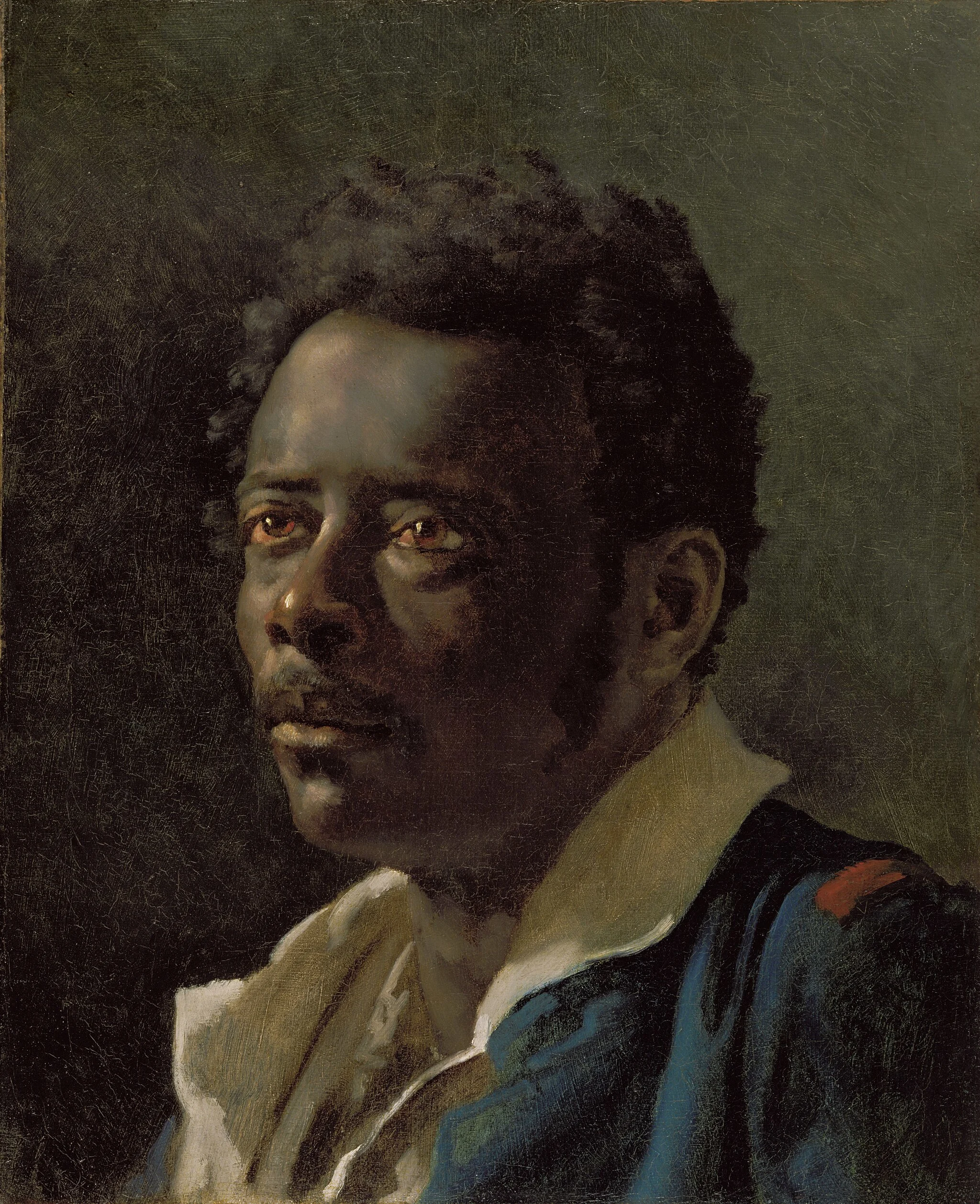
Joseph, born into enslavement in Saint-Domingue, became a world-renowned model in Paris thanks to Géricault's The Raft of the Medusa.
Who was Joseph?
We know his face and body well. We know his first name ‘Joseph’ and his nicknames which are derogatory: 'Negro Joseph' or 'Joseph the Moor'. But we know little about the man.

Joseph is said to have been born around 1793 in Saint Domingue (present-day Haiti), at a time when the enslaved population was rebelling and freeing themselves. He is said to have arrived in Europe via Marseille about ten years later in 1804.
How did Joseph become a model for the Raft of the Medusa?
It was in Paris that his career took off as a model. He arrived in 1808 and initially joined a troupe of acrobats. He was admired for his athletic build and broad shoulders. Fascinations about him responded to the clichés of the time about the Black body, stereotyped as ‘exotic’.
During an acrobatic show, he was noticed by the painter Théodore Géricault with whom he would forge a friendship.

The latter who engaged in the abolitionist struggle through his art, notably had Joseph pose for his famous painting, The Raft of the Medusa (painted in 1818/1819).
He served as the model for the three silhouettes of Black men that can be seen in the painting, including that of the sailor who dominates the human pyramid on the drifting raft, and who, by waving the scarf of the last collective hope, gives a universalism and anti-slavery meaning to the painting.


The work had such an impact that it opened the doors to other painters' studios for Joseph. He became one of the three official male models of the École des Beaux Arts, for a salary corresponding to a quarter of that of a professor at the School. He posed for artists such as Horace Vernet, Théodore Chassériau, Adolphe Brune and Charles Gleyre.

The recurring presence in Parisian studios of Joseph, who was called 'jovial', according to the stereotypes of the time, led to the publication of an article by Le Figaro in 1858. 'There is not a single artist in France, painter or sculptor who does not know Joseph the Negro, the most beautiful model who has visited the studios of Paris.'
What happened to Joseph?

Through his charisma, his professionalism, and the longevity of his presence in Paris, he embodied in the eyes of generations of artists he inspired - and the admirers of their works - a human figure of ‘otherness’, at a time when racism, on the contrary, animalised Africans. His body was used with respect like we can see from Géricault’s depictions yet also to perpetuate further stereotypes by other artists.
As he grew old, we lose track of him, and he died anonymously and destitute, probably around 1860/1870.
What remains of Joseph is the memory of his body multiplied in artworks like The Raft of Medusa which continue to strike us two centuries later.
In 2021, French writer Arnaud Beunaiche published Je suis Joseph, a fictional biography of Joseph. The Getty Museum dedicated an entire digital exhibition in 2023, through Google Arts & Culture to Joseph titled Study of the Model Joseph, Nineteenth-Century Paris, and Romanticism.
Thank you to Fondation pour la Mémoire de L’esclavage (FME) for sharing this story with Europeana.