
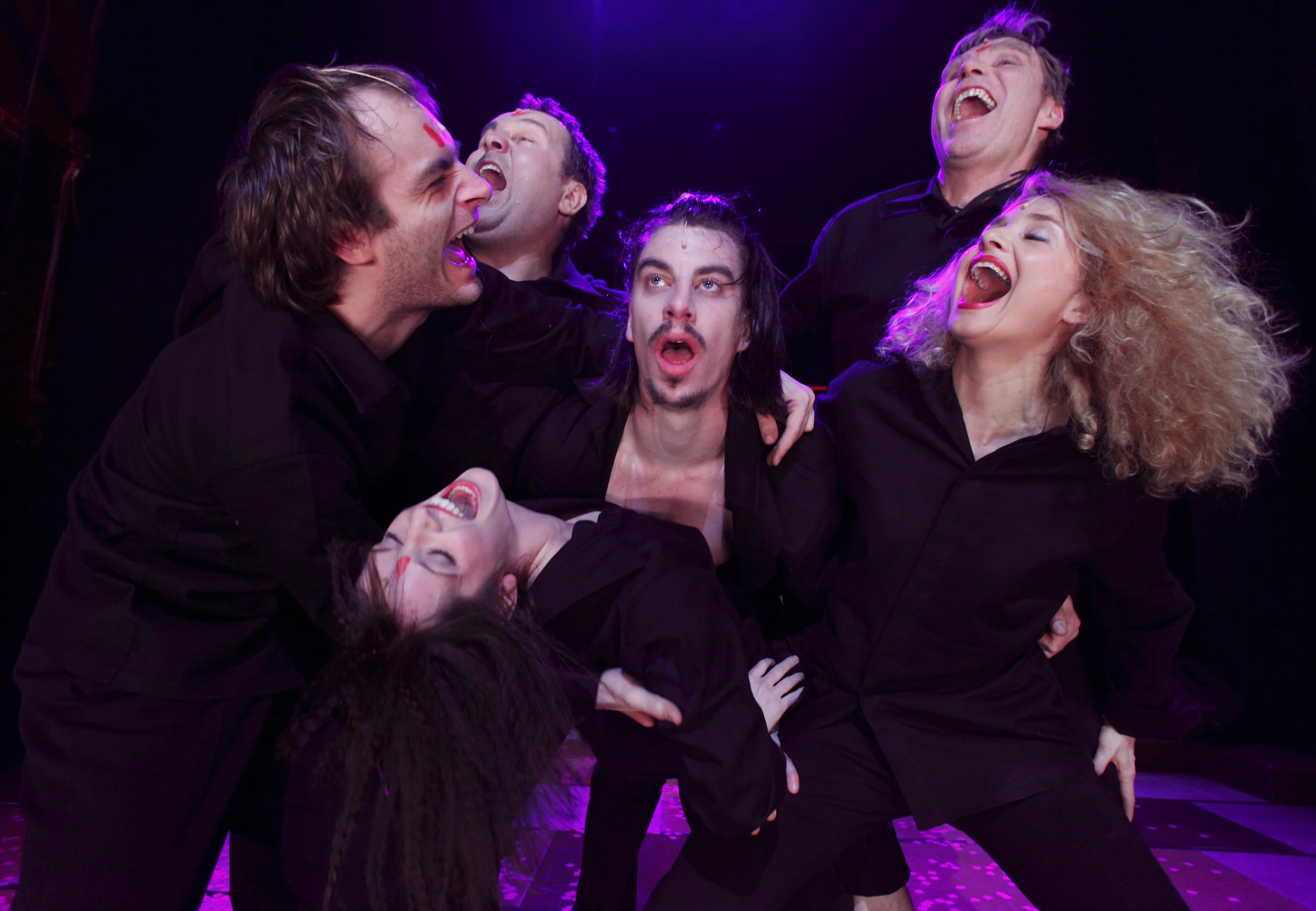
'It's all very Brechtian' - a phrase we've heard many times referring to some theatrical production or other. I take it to mean that there's minimal set, the actors are all very serious, they wear black and they spend most of their time with their backs to the audience.
So, to me, Brecht looks like something like this...
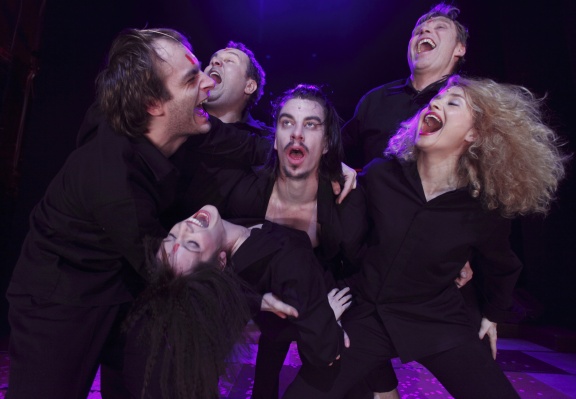
'Theatre performance Bobni v noči by Bertolt Brecht', Slovenian National E-content Aggregator, Culture.si photo library, CC-BY-ND Or this...
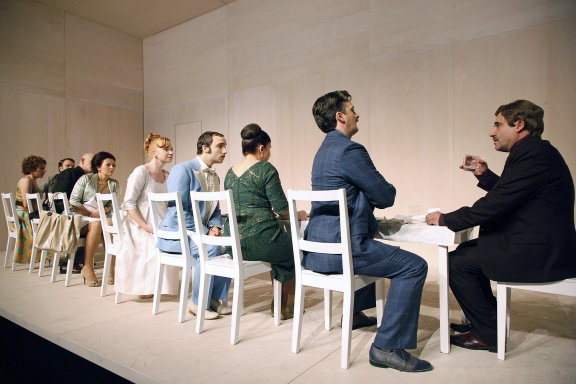
'Brecht's A Respectable Wedding, directed by Mateja Koležnik', Culture.si photo library, Slovenian National e-Content Aggregator, CC-BY-ND
But what does the term 'Brechtian' really mean?
Bertolt Brecht was a German playwright, he was born in 1898 and died on the 14 August 1956, aged 58.
As well as his many plays, Brecht wrote a lot about the theory behind his works and the dramatic devices he used. Some of the terms used to describe these devices are: epic theatre, verfremdungsteffekt/alienation effect, didacticism, breaking the fourth wall, gestus, narration and use of song.
Those terms may not mean much to you unless you're already familiar with theatre and its techniques. In a nutshell, Brecht wanted to make his audiences think, not just feel. He objected to theatre presenting events as reality and thought that left little room for political or social comment.
Brecht changed the rules of theatre, disrupting the sense of reality by distancing the actors and audiences from the events being portrayed, making things that should be familiar strange in order to make the audience think rather than simply accept, and using contradictions to create complex characters.
By doing this, Brecht created something radical, a new style of theatre that allowed him to make the political and social comment he desired. Find out more about Brecht's techniques.
Mother Courage and her Children is possibly Brecht's most famous play. It is an anti-war play thought by some to be the greatest play of the 20th century. It was written in 1939 after Germany invaded Poland, and first performed in 1941.
The Threepenny Opera is a musical Brecht wrote with composer Kurt Weill which was adapted from John Gay's The Beggar's Opera and is a critique of the capitalist world.
It mocked the sentimental musical and was a great success, but because the audience loved the sentiment and missed the humour. You may even know one of its songs without knowing its origin. The famous song Mack the Knife, sung by amongst others Bing Crosby, Ella Fitzgerald, Frank Sinatra and Robbie Williams, comes from the show's 'The Ballad of Mack the Knife'.
Below is a gallery of posters and magazine spreads from Brecht's plays. All of which you can find on Europeana and are public domain images from Hungarian Theatre Museum and Institute and e-Library for Performing Arts.


What does the term 'Brechtian' really mean?
Bertolt Brecht was a German playwright. He was born in 1898 and died on the 14 August 1956, aged 58.
As well as his many plays, Brecht wrote a lot about the theory behind his works and the dramatic devices he used. Some of the terms used to describe these devices are: epic theatre, verfremdungsteffekt / alienation effect, didacticism, breaking the fourth wall, gestus, narration and use of song.
Those terms may not mean much to you unless you're already familiar with theatre and its techniques.
In a nutshell, Brecht wanted to make his audiences think, not just feel. He objected to theatre presenting events as reality and thought that left little room for political or social comment.
Brecht changed the rules of theatre, disrupting the sense of reality by distancing the actors and audiences from the events being portrayed, making things that should be familiar strange in order to make the audience think rather than simply accept, and using contradictions to create complex characters.
By doing this, Brecht created something radical, a new style of theatre that allowed him to make the political and social comment he desired.
Mother Courage and her Children is possibly Brecht's most famous play. It is an anti-war play thought by some to be the greatest play of the 20th century. It was written in 1939 after Nazi Germany invaded Poland, and first performed in 1941.
The Threepenny Opera is a musical Brecht wrote with composer Kurt Weill which was adapted from John Gay's The Beggar's Opera and is a critique of the capitalist world.
It mocked the sentimental musical and was a great success, but because the audience loved the sentiment and missed the humour. You may even know one of its songs without knowing its origin. The famous song 'Mack the Knife', sung by amongst others Bing Crosby, Ella Fitzgerald, Frank Sinatra and Robbie Williams, comes from the show's 'The Ballad of Mack the Knife'.
Below is a gallery of posters and magazine spreads from Brecht's plays. All of which you can find on Europeana and are public domain images from Hungarian Theatre Museum and Institute and e-Library for Performing Arts.


Want to know more about Brecht? Try this introductory film from the UK's National Theatre.
Niestety, tej treści nie można wyświetlić.
Wyświetl tę zawartość za pośrednictwem łącza zewnętrznego