
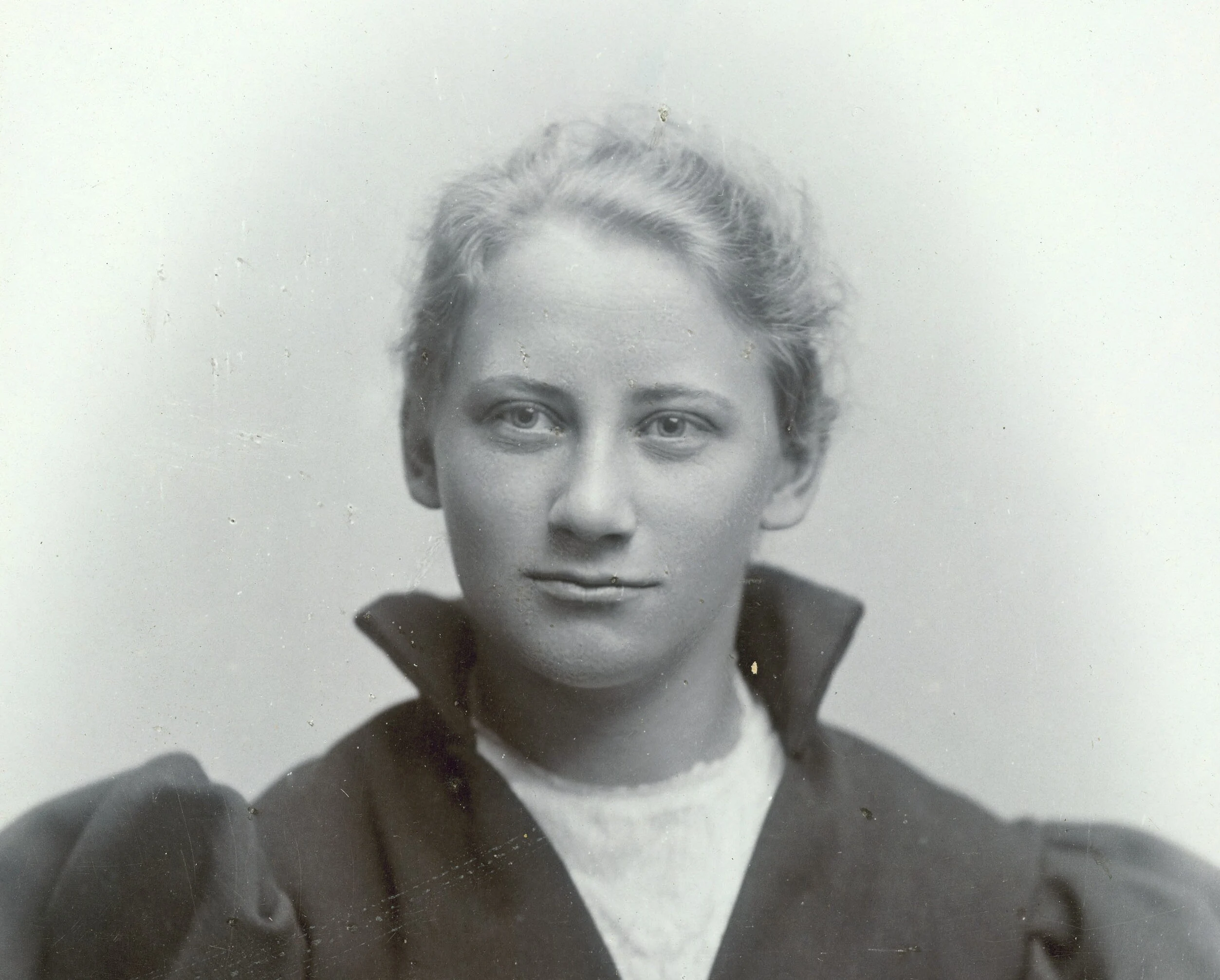
How Danish journalist Ellen Hørup supported Mahatma Gandhi’s India and shaped Europe’s evolving political imagination
Ellen Hørup was a Danish feminist, journalist and pacifist. Despite the limited role women played in foreign politics in the early 20th century, Hørup emerged as a significant figure, as one of the first female foreign policy journalists in Denmark.
From the late 1920s, she wrote extensively on Gandhi and Indian liberation, as well as contributing to the establishment of the Indian freedom support group in Europe in the 1930s.
Ahimsa (non-violence) in Europe

After experiencing the two World Wars, Europeans took the responsibility of rebuilding society through new popular movements to ensure peace and justice.
These new popular movements in the context of Europe refer to the broad civic initiatives that had their peak after World War II. New social movements include peace movements, 'Third World' liberation and solidarity movements, women's rights and feminist movements, environmental movements and so on.

The movement against atomic armament was the first broad popular movement in post-war Europe in the beginning of the 1960s. Despite looking back into the well-documented history of European revolutions, people at this time wanted to explore an alternative method to take action towards peace and justice. They took inspiration from Mahatma Gandhi's philosophy of ahimsa (non-violence) and the Indian popular movements.

In Nordic countries, the political landscape (1960-68) had been completely changed through new popular movements inspired by the idea of ahimsa and Gandhian methods of non-violent intervention and action. This included boycotts against oppressive regimes, padyatras or long marches linked to direct action, intervention by direct non-violent intervention in conflicts, and mass support for constructive programmes to give humanitarian support to liberation movement territories.
However, until 1921, Mohandas Karamchand Gandhi and his non-violent struggle for freedom in South Africa and then in the Indian Subcontinent were limited to a small group of Danish missionaries in India and their friends back home.
So how did Gandhian ideas and ideals travel and plant their seeds in the heart of Europe?
Ellen Hørup

In a quiet corner of Gentofte Kirkegård in Copenhagen lies the grave of a woman who once spread the seeds of ahimsa long before sit-ins and peace marches swept the continent.

Ellen Hørup was a modern feminist, pacifist and anti-fascist. In her 40s, she became involved in journalism, contributing regularly to the influential Danish newspaper Politiken.
Ellen Hørup's early life and career
Born on 29 December 1871 in Copenhagen, Ellen Gunhilde Hørup grew up in a rather radical home. Her mother Emma Hørup was a school teacher and her father Viggo Hørup was an anti-militarist and the founder of Politiken. For her first 40 years, she had been very active in sports. She was Denmark's first female rower and racing cyclist. She was also the fifth female dentist in Denmark.

Her first work in Politiken, published in 1928, was about Mahatma Gandhi and his non-violent struggle against British imperialism in India. As a journalist, Hørup wrote more than 600 feature articles and editorials, and more than 300 shorter articles in newspapers, magazines and books about international politics, armament and disarmament, and imperialism. She also wrote against fascism and Nazism, against totalitarian governments, and militarism, including NATO.
Discovering Mahatma Gandhi and India
After her mother’s death in 1923, Hørup left Denmark, divorced her husband, and settled in Rome.

There, she was involved in Italian translations of Hans Christian Andersen's fairy tales and published them in a series, in Corriere Magistrale, the journal of the Independent Italian Teachers’ Union. At this time, she became acquainted with Mahatma Gandhi and his non-violent struggle for freedom. It was a turning point. Hørup decided to carry on journalistic work in Politiken by featuring the activities of Indian National Congress as well as Gandhi.

In January 1929, she travelled to India with Danish artist Cathinca Olsen. They stayed at Gandhi’s ashram at Sabarmati for over a week. After returning to Denmark, Hørup wrote articles on Gandhi and his ashram.
Breaking the censorship barrier
After the Salt March of 1930 in India, the British government tightened censorship, restricting news from India.

Ellen Hørup along with her friends across Europe and America created a small informal group whose members visited India from time to time on their own.
The group took an interest in the severe repression during the 1930-31 Civil Disobedience Movement in India led by Gandhi. Hørup stayed in India for four months during this time. She met Gandhi, as well as other Indian leaders such as Jawaharlal Nehru, Moulana Abul Kalam Azad and Subhas Chandra Bose.

The members of this informal international group distributed the suppressed news in European languages other than English. Their investigative journalism approach managed to break the 'iron curtain' that the British government had set up to isolate the Indians and make their liberation impossible.

Shortly after the visit, in December 1931, Hørup published her book about the journey to India, Gandhis Indien (Gandhi's India). In her words:
'His [Gandhi’s] ideas, my admiration for him, the longing to meet the man who gave me what I have been seeking all my life – something which together is called devotion, reverence and love – was what led me twice to India.'
Building support in Europe for India’s independence
Ellen Hørup was active in informing the European public about India’s struggle for independence and promoting support.
In October 1930, she set up Indiens Venner (Friends of India Society) in Denmark, as well as establishing a monthly magazine with the same name. The magazine was active until 1938 and devoted fully to the Indian liberation struggle as well as Mahatma Gandhi. Soon, inspired by Indiens Venner, Bokken Lasson, a Norwegian friend of Hørup, set up Friends of India Society in Norway.

Gandhi arrived in London during the Round Table Conference (1931) on Indian constitutional reform. Hørup joined there to stand with Gandhi.
In 1937, the Friends of India Society in Norway nominated Gandhi for the Nobel Peace Prize. Hørup wrote to a number of influential persons and organisations for support. Positive replies came from all across Europe: Romain Rolland from France, C. F. Andrews from the UK, Bart de Ligt from the Netherlands, Maria Montessori from Italy, Professor Ludvig Quidde from Germany, Henrik Pontoppidan, J. Hassing-Jørgensen and Edv. Larsen from Denmark, as well as numerous other individuals and organisations.

In October 1932, Ellen Hørup organised an international conference for India in Geneva.
With Dr. Edmond Privat of Switzerland as President, Madeleine Rolland of France as Vice-President and Hørup as Honorary Secretary, an International Committee for India was established. The committee published Indian Press, with Hørup as a main contributor. It became the first international magazine to support the Indian cause abroad.
Ellen Hørup was a founding member of the board of the Danish-Indian Friendship Union, established in 1948, after India became independent.
Ellen Hørup's legacy
During the Nazi occupation (1940-45) in Denmark in World War II, Hørup was unable to write about foreign political matters. She set her mind upon writing about children, the future citizens, becoming a strong critic of Danish public childcare.

Within a few months of Indian Independence in August 1947, Mahatma Gandhi was assassinated. The Polish newspaper Głos Wielkopolski reported this, writing that 'the East lost the greatest man of our time'. Indeed, Gandhi and India's freedom struggle set an example for the whole colonised world in Africa, Asia and Latin America.

Ellen Hørup, through her journalism, activism, and international organising, paved one of the key pathways through which ahimsa entered European consciousness.

Today, as non-violent grassroots movements regularly make headlines all across Europe, the story of Ellen Hørup highlights the pivotal role of a Danish woman in transmitting Gandhian ideas to Denmark and gradually the whole continent. By combining journalism, activism, and international organising, she planted the seeds of non-violent civil resistance in the heart of Europe which is still a living practice.

Further reading
- H. Larsen, Ellen Hørup – Dansk Biografisk Leksikon | Lex
- Friends of Gandhi, Correspondence of Mahatma Gandhi with Esther Færing (Menon), Anne Marie Petersen and Ellen Hørup, Edited by E.S. Reddy and Holger Terp, PDF
- Gandhi and the new popular movements in Europe, Tord Björk and Marko Ulvila, PDF
- Gandhian and Indian Influence in the Nordic Countries, Tord Björk, Folkrörelser och Protester
- Reclaim Gandhi, Indian-Nordic encounters 1917-2006, Tord Björk, PDF
- The Danish Peace Academy, Gandhi and Nordic Countries, edited by E. S. Reddy and Holger Terp, The Danish Peace Academy
This blog was made possible through Europeana's editorial grants programme which provides funding for writing that put a spotlight on underrepresented communities, voices and lived experiences. Learn more about the editorial grants programme and how to apply.