17 risultati all'interno di Luogo Nether Wallop

17 risultati restituiti

Nether Wallop

Village and civil parish in Hampshire, United Kingdom

Museum of English Rural Life, University of Reading

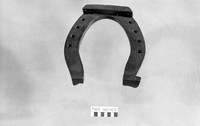
This is a front horseshoe for a carriage horse. It has six nail holes which are very close to the rim. It was made by H. J. W. Duke of Nether Wallop, Hampshire, circa 1945–6, and is part of a large collection of traditional craft products acquired from th…

Museum of English Rural Life, University of Reading

This ‘open bar shoe’ is for a cart horse. The shoe is fullered, meaning it has a groove running along the surface into which the nail holes are placed, with seven nail holes. It was made by H. J. W. Duke of Nether Wallop, Hampshire, circa 1945–6, and is p…

Museum of English Rural Life, University of Reading

This horseshoe is for the hind foot of a cart horse. It has a ‘caulk’, or ‘caulkin’, (a protrusion at the heel or toe of a shoe which provides traction) at the end of either wing, and another running across the toe of the shoe. The shoe has seven nail hol…

Museum of English Rural Life, University of Reading

This corrective horseshoe is intended to correct a ‘speedy cut’ in which the horse doesn’t rise unless going fast. The shoe is fullered, with five nail holes, and has a flat flange to one side. It was made by H. J. W. Duke of Nether Wallop, Hampshire, cir…

Museum of English Rural Life, University of Reading

This corrective horseshoe is intended to prevent 'forging' – when the toe of the hind shoe strikes the front shoe when the horse is trotting. It is a ‘diamond toed’ shoe in which the toe is shaped into a point. It is fullered, with six nail holes.…

Museum of English Rural Life, University of Reading

This horseshoe is intended for a carriage horse. It is a ‘caulk and wedge’ shoe, with one prong ending in a caulkin (a protrusion at the toe or heel of a shoe to provide additional traction) and the other ending in a wedge (which also provides additional …

Museum of English Rural Life, University of Reading

This ‘open bar shoe for frog dressing’ is for a carriage horse. One wing of the shoe is ridged on its outer face and has four nail holes; the un-ridged wing has two nail holes. The shoe was made by H. J. W. Duke of Nether Wallop, Hampshire, circa 1945–6, …

Museum of English Rural Life, University of Reading

This horseshoe is for the front foot of a cart horse. It has a ‘caulk’, or ‘caulkin’, (a protrusion at the heel or toe of a shoe which provides traction) at the end of one wing, and another running across the toe of the shoe. The shoe has eight nail holes…

Museum of English Rural Life, University of Reading

This corrective horseshoe is intended to help with contraction of the foot by putting pressure on the frog. It is a T-shaped shoe in which the upright fits over the frog. It is fullered, with six evenly spaced nail holes. It was made by H. J. W. Duke of …

Museum of English Rural Life, University of Reading

This corrective horseshoe, for a cart horse, is intended to cure laminitis – an inflammation of part of the foot. The shoe is very wide and has two caulks, or ‘caulkins’ – protrusions at the heel or toe of a shoe which provide additional traction. The sh…

Museum of English Rural Life, University of Reading

This corrective horseshoe, for a cart horse, is intended to prevent ‘knocking’ –when the horse strikes the inside of one leg with another. The shoe has eight nail holes, and a long curved wing which loops over the front of the hoof. It was made by H. J. W…

Museum of English Rural Life, University of Reading

This corrective horseshoe is intended to help with twisted legs. It is an open bar shoe with a ‘rose piece toe’. It is fullered, with six nail holes. It was made by H. J. W. Duke of Nether Wallop, Hampshire, circa 1945–6, and is part of a large collectio…

Museum of English Rural Life, University of Reading

This corrective horseshoe, for a cart horse, is used to help support the heel and is known as a ‘bar shoe’. This shoe has ten evenly spaced nail holes. It was made by H. J. W. Duke of Nether Wallop, Hampshire, circa 1945–6, and is part of a large collecti…

Museum of English Rural Life, University of Reading

This corrective horseshoe, for a cart horse, is intended to provide support for a horse with a sprained tendon. The two wings of the shoe are link withed a raised bar. The shoe has seven nail holes. It was made by H. J. W. Duke of Nether Wallop, Hampshire…

Museum of English Rural Life, University of Reading

This is a ‘hunter shoe’ – a horseshoe for a hunting horse – and is therefore designed to cope with travelling quickly over soft ground. This is a hind shoe. It is fullered on the wings only, with six nail holes. It was made by H. J. W. Duke of Nether Wall…

Museum of English Rural Life, University of Reading

This is a ‘hunter shoe’ – a horseshoe for a hunting horse – and is therefore designed to cope with travelling quickly over soft ground. This is a front shoe. It is fullered all the way round, with six nail holes. It was made by H. J. W. Duke of Nether Wal…

Museum of English Rural Life, University of Reading

This ‘caulk and wedge brushing shoe’ is for a carriage horse and is intended to prevent ‘brushing’ – when the horse strikes the inside of one leg with another. A ‘caulk’, or ‘caulkin’, is a protrusion at the toe or heel of a shoe which provides additional…