
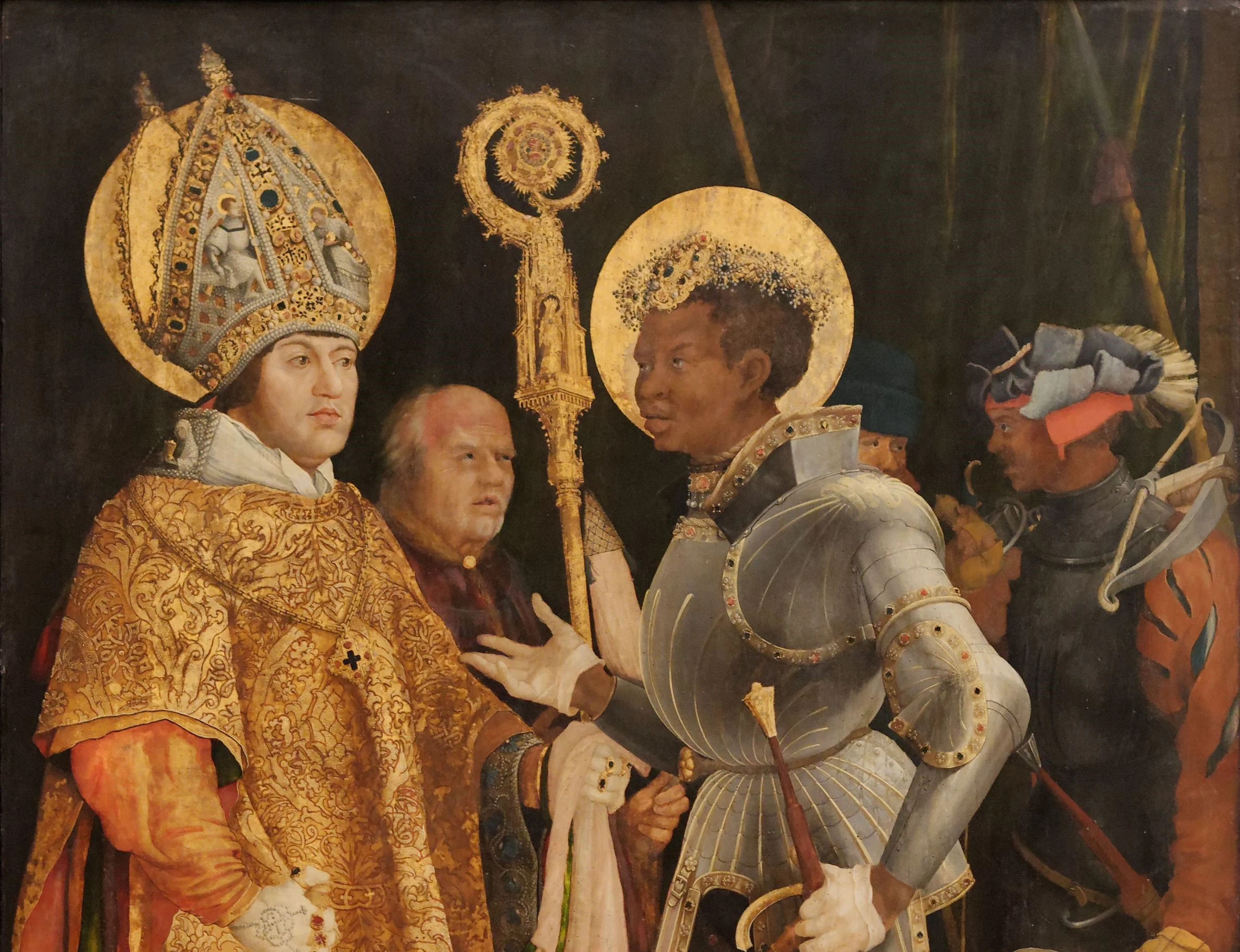
Who is Saint Maurice and how did he become a saint?
Saint Maurice is the patron saint of the Holy Roman Empire, has a statue in the Vatican and is depicted in many churches, most notably across Germany. But little is known about the saint, most probably because he might have never actually lived.
There is no historical consensus about Saint Maurice's life and martyrdom. Some historians point to Saint Maurice being a pure fabrication of medieval Christian beliefs, while some claim that he really lived but his legacy has been altered throughout the ages.
So who is Saint Maurice? What did he do to become a saint and how did his image become the first artistic depiction of Black people in Europe?


The myth of Saint Maurice
Saint Maurice is said to have led a Theban Legion of Christian Roman soldiers in the 3rd century.
The Roman emperor Maximian commanded Maurice's legion to march to Agaunum. Today, Agaunum is named after Saint Maurice, you'll find it on the map as St-Maurice en Valais in Switzerland. The emperor had given the soldiers instructions that Maurice, an avowed Christian, could not follow in good faith.
What exactly the Emperor had ordered is unclear: he might have told the legion to give offerings to pagan gods, or he might have asked the legion to harass or kill local Christian townsfolk. Maurice pleaded with his legion not to follow these orders. The legion sided with Maurice and refused to act out Maximian's bidding.
As punishment, Maximian ordered the legion to be decimated. As the etymology of the word 'decimated' (from the Latin decimatus, meaning destroying one in ten), this meant that for every ten soldiers, one was to be executed.


This did not scare the Thebean Legion, who continued to refuse orders, suffering a second decimation as punishment from the emperor. Bolstered by Maurice's resolve, the Thebean legion still did not budge on their stance - Maximian ordered the entire Legion to be killed. So Maurice was martyred.
The veracity of this myth is hard to verify. The earliest accounts of this event only appeared 150 years after the fact, when Maurice was declared a saint for his martyrdom by the hand of Maximian.


Saint Maurice's legacy
Since it's not even sure if Saint Maurice was a real historical figure or just a myth, it's almost impossible to speculate on what Saint Maurice would have even looked like, if he did exist.
Until the 13th century, Saint Maurice was always depicted as a white man in soldier's outfit.
In Magdeburg, in Germany, an abbey dedicated to Saint Maurice (Sankt Moritz) was erected in 937, and was expanded to a cathedral in 955. The cathedral was completely destroyed in 1207 by a city-wide fire. During its reconstruction, a new statue in honour of Saint Maurice was placed in the cathedral, made by an unknown artist. This artist chose to depict Saint Maurice with black skin.

The reason for depicting Saint Maurice in this way is unclear. The artist might have interpreted Saint Maurice's background as a soldier of Thebes, in northern Egypt, as an indication that Maurice must have been Black. What is sure is that, with this change, for the first time a Black African was being depicted in medieval European art.
Depicting Saint Maurice as a person of colour did not stop at the statue in Magdeburg.
More churches throughout Germany, Switzerland, France and Italy started showing Saint Maurice as a Black man in their statues, paintings and manuscripts. This trend did not spread throughout all of Europe: other churches in other countries continued to visualise Saint Maurice as white.


Statues, paintings, reliefs and other depictions of Saint Maurice still stand in many churches, abbeys and cathedrals in Germany. Even though his appearance and past are contested, he remains an important piece of Black iconography in Europe.