
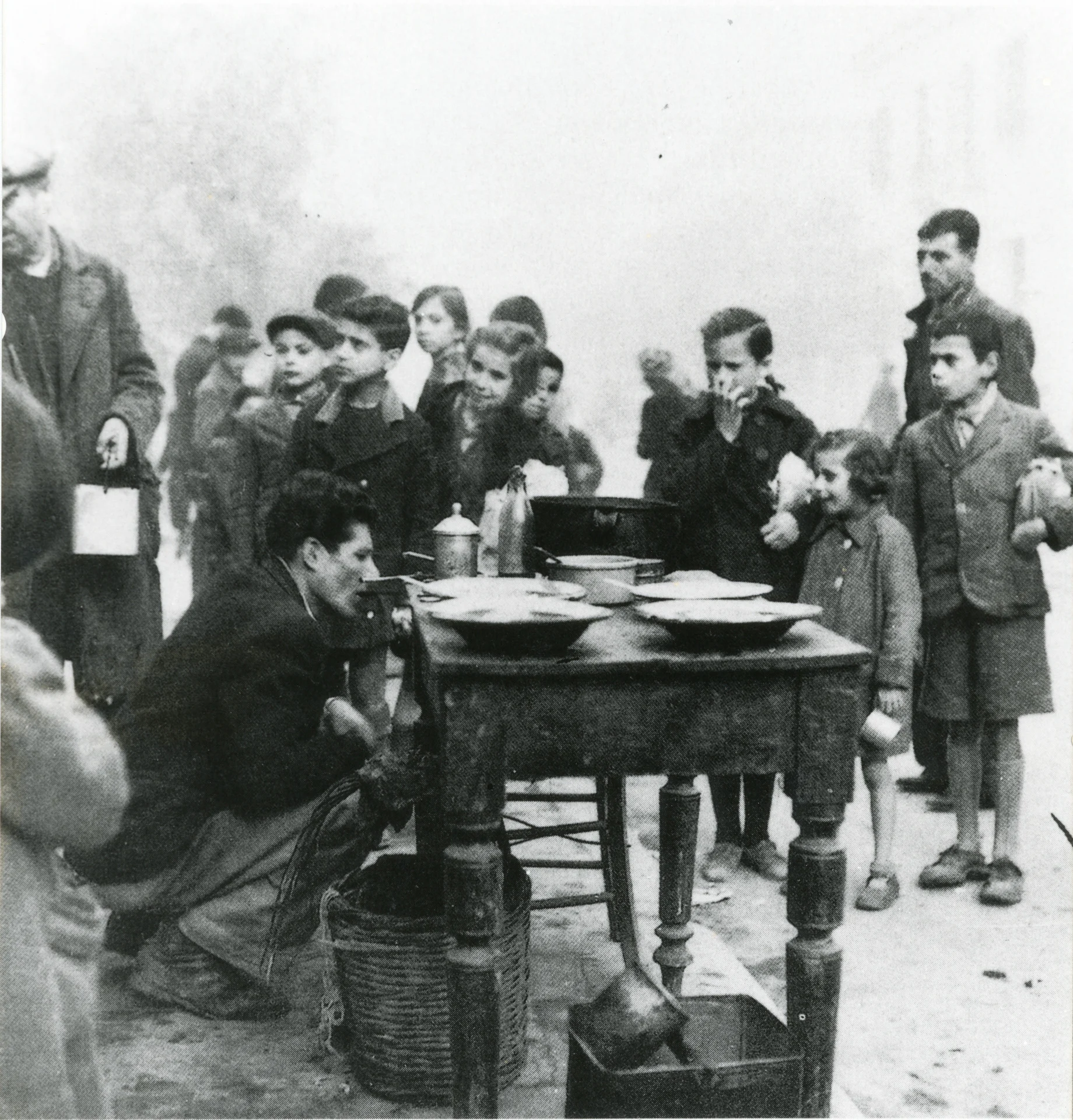
Yannis Ritsos, one of the most important poets of the 20th century, made poetry out of his own lived experience. Political and human at the same time, he spoke of war, resistance, peace, memory, and life.
Though Yannis Ritsos lived and created in a specific place and time, he could have been writing about any corner of the earth where people struggle for justice. Greece in 1945 could be Syria in 2012, Palestine in 2025. Ritsos writes for the past, the present and the future, for as long as there is exploitation of one person by another. He writes of hunger and of love – hunger for freedom, for bread, for justice for all; and love that makes people keep trying, love that makes people share even their smallest piece of bread.

War is war, and hunger is hunger. The specific excuses and conditions change with time and place, but some elements always remain the same.
In hindsight, the pretexts put forth always seem small compared to the destruction they brought. War brings to the surface whatever each person hides. In some, pettiness bursts forth, and they try to profit from the horror. These people are always against us.
Our own people, our brothers and sisters, are elsewhere: they fight for justice, guided by love for humanity, struggling for a better tomorrow for all. This struggle keeps their image alive.
So many years besieged by land and sea,
Everyone is hungry, everyone is killed, and no one has died.
(Y. Ritsos – Romiosini)
The mother who loves her child. The rebel who loves the people. The person who loves his neighbor.
Now we have learned some simple things,
very simple,
very certain,
that the sky begins with bread,
that it is not right for some to make the bread
and others to eat the bread,
that it is not right to make cannons
and lack ploughs – simple things.
(Y. Ritsos – Letter to Zolio-Curie)
Everyone hungers differently. The mother hungers for her child and, only after they have eaten, for herself. The child becomes entirely a stomach that hungers. The soldier hungers too, but for other things – and remains silent.
I am ashamed of this paper,
ashamed of the words,
ashamed of the glass of water,
ashamed that I am thirsty,
ashamed that I drink,
I cry,
ashamed that I cry.
(Y. Ritsos – excerpt from Sobbing V, collection Ydria)
In times of war, so many people hunger for so many things: for food, for words, for truth, for justice.
I left two olives and a little bread on the table. Because father might come. Or the homeland.
(Y. Ritsos – Blackened Pot)
The child chews a dried fig. Holds it, chews it, holds it – making the taste last longer than the hunger. The child imagines the father armed on horseback but can no longer see his face clearly.
The mother boils oregano and water. She will call it soup. In her imagination, she spreads oil on bread. The first piece she gives to the child. Even in her dreams, first she feeds the child.
We measured the oil drop by drop, like our tears.
(Y. Ritsos – Moonlight Sonata)

War is not only battles and gunfire. It is silence in the houses, queues for a little flour, papers with lists of the names of the dead. It is walls that hold the voices of children who are gone. It is absence at the table, the plate that stays empty, the garment that smells of soil and blood.
War takes the father’s voice, the mother’s shadow, the child’s innocence. It makes heroes out of necessity, not always out of choice – and leaves them to starve.
The soldier does not hunger only for food. He hungers for a touch, for a return, for peace. But he does not speak. He looks at the earth. Steps on it and continues.
The mother washes her son’s clothing every day so it will be fresh when he returns. She wears it in hope of bringing him back. The mother worries:
Who will now bring you the warm loaf in the night to feed your dreams?
(Y. Ritsos – Romiosini)
The child draws tanks and bombs, not suns and houses. Because that is what he has seen. That is what he lives.
War is the fear that grips the stomach before the knock at the door. It is the bread that is not enough for everyone.
The fighter thinks, too:
Hunger alone governs.
That is why the hungry are easily governed.
(Y. Ritsos – Graganta, 1972)
But he does not accept it. Because he still holds in his hands a piece of bread to share. Not because he has had his fill, but to remember that he is human.
They ask back for the bread they never ate.
They ask for the sun that was stolen from them.
The dead ask for their lives.
HALT – HALT
from all the night’s outposts
all night long.
(Y. Ritsos – Romiosini)
War does not end with an armistice. It remains in memories, in nightmares, in verses. It remains in the knot in the throat when you see an empty plate and have nothing to say. Until the final victory. Until no child waits in a queue for their meal.

The soldier took a piece of hard bread out of his rucksack. He looked at it as if for the first time. Beside it, an olive, a gift from an old farmer. He had two and gave away one. He ate as if receiving communion.
A piece of bread and a glass of wine – people lived on these / and endured.
(Y. Ritsos – Stone Years)
Now, without even these. Not even stale bread, no wine to receive communion with.
The bread is finished, the bullets are finished.
Now they fill their cannons only with their hearts.
(Y. Ritsos – Romiosini)
He remembered his mother saying: When you cut bread, cross it first. When you share, first give to the hungry.
He remembered the old table, the pot steaming, his father saying food unites and makes ground for us to stand on.
At home, the mother broke the rusk in two. The child refused. She soaked it, served it with olives.
Eat, my child. Hunger is not shame. Forgetfulness is.
(Y. Ritsos – 18 Little Songs of the Bitter Homeland)
– Mama, when brother comes back, will we all eat together? – Yes, my child. We will have meat and wine. – And grapes? – And figs. And basil on the table.

The soldier returned. With torn shoes, worn uniform, and a loaf – a gift of a comrade. The mother placed it on the table. It was no longer just bread. It was memory. It was homeland. It was struggle.
On the table: olives, a drop of oil, a little wine, a piece of cured meat.
Peace is the clenched hands of people,
is the warm bread on the world’s table,
is the mother’s smile.
Only that.
Nothing else is peace.
And the ploughs that carve deep furrows all over the earth
write only one name:
Peace. Nothing else. Peace.
(Y. Ritsos – Peace)
The mother opened an old wine. The child gathered flowers from the neighborhood. They all ate together.
We shared the bread- and stood silent.
Because this silence was full
(Y. Ritsos – The Lady of the Vineyards)
And then, they were not hungry. Not because they had eaten their fill, but because they were together.
Translations of Greek texts by Alta Panera.
