
What is the history of the University Library of Leuven?
The city of Leuven is Belgium is home to the country's oldest and largest university, which was founded in 1425. The city has many buildings dedicated to the university, with the university's library on a city square as a highlight.
Leuven University's library has had a past as rich as it has been turbulent - with religious conflicts, political discord and war-time catastrophes.
Read on to discover the history of this beautiful building.
The beginnings of Leuven's university
The first university founded in Leuven dates to the 15th century, and is now known as the Old University of Leuven.
The first university rector, Willem Neve, travelled to Rome to ask the pope for his blessing in the founding of a new university. Pope Martinus V decreed the founding of Leuven's university on 9 December 1425, making it the first university in the Low Countries.

However, it was not until the 17th century that Leuven's university founded a university library. Before then, students and professors had to rely on private collections to inspire their research and discussions.
In 1636, a university library was founded and housed in the Cloth Hall, a building used by the university. The Cloth Hall was a building that originated in the Middle Ages as a trading and storage place for cloth and was home to the cloth weavers guild.

Leuven University under threat
Leuven's university was founded as a Catholic university and this status remained throughout the next centuries.
During the 16th century, Protestant books were burned and an index was created at the library that listed forbidden books of Lutheran writing. The Louvain Index was the inspiration for the famous Index Librorum Prohibitorum later created by the Pope which contained a long list of forbidden books.

The French Revolutionary wars led to Belgium becoming part of France in 1795. During this time, all universities were abolished to make way for new Écoles Centrales could be founded.
The Leuven university disbanded in 1797. The rich collection of its library was partly transported to Brussels' École Centrale and to the Bibliothèque Nationale de France in Paris. Ironically, the abolishment of Leuven university library meant that most of its precious historical library was saved from future devastation.

The first half of the 19th century was also turbulent for Leuven's University.
In 1817 the Rijksuniversiteit Leuven was founded, a non-denominational state-driven university. Belgium gained its independence from the Netherlands in 1830 and founded a new Catholic University in Mechelen in 1834.
A year later, the university library moved back to Leuven, where the original Catholic University had resided for centuries. The library in the Cloth Hall was reinstated.

20th century catatrosphes
Catastrophe struck again in the 20th century. In 1914, at the start of World War I, the university library in the Cloth Hall was burned to the ground by German forces.


About 300,000 invaluable books were lost in the fire. Luckily, the most valuable had been transported to Brussels and Paris more than a century earlier, saving a wealth of heritage and information from the flames.
The burning of the library was widely used in anti-German propaganda to show the destruction and ruthlessness of the German soldiers.


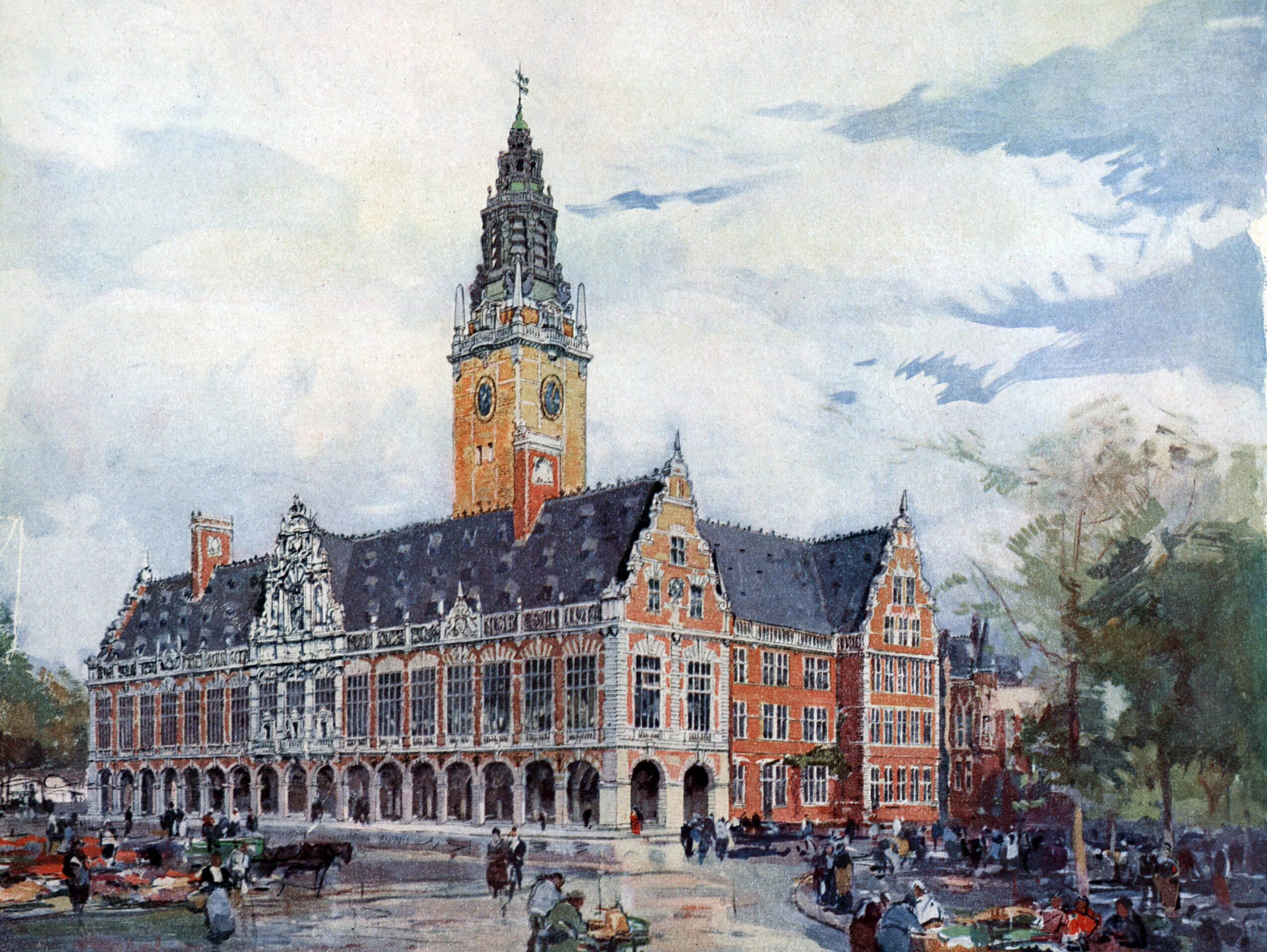
This outrage sparked a movement that helped reinstate the library in a new building after the war, aided largely by the Belgian Relief Fund founded by Herbert Hoover. With this money, a new monumental library was built and finished in 1928. The new building has a neo-Flemish Renaissance architectural style, which suggests its longer history.
The library's book collection was rebuilt with donations from around the world.
During World War II, the library was again endangered. The Battle of Leuven took place on 16 May 1940. The library went on fire, during an artillery exchange between German and British forces. Both sides accused each other of inflicting the damage. Books and manuscripts were reduced to ashes.
Remarkably, Leuven University remained open during the war, with a temporary library. After World War II, the library began rebuilding. The building was reconstructed almost completely to the original plans, while donations again contributed to the collections.
Since 1987, the library building has been deemed a protected monument reflecting its historic important and embattled history.


