
29
Ergebnisse innerhalb von
Person
 Eugenio Caxés
Eugenio Caxés
Spanischer Maler zwischen Manierismus und Barock

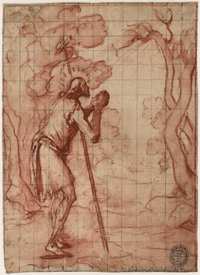
Stylistic and thematically related to the drawing “Elder in an attitude of worship” (Dib/15/1/19), with which he plays a partner in a way that is currently different, although originally they may form unity, as Barcia suggests.; Central Filigrana; Angulo …
On the montage, in graphite pencil: “62”; Attributed, with doubts, to Eugenio Cajés, by Barcia
Manuscript inscription, in brown ink, in the center of the verse: “Fran.co. Urgel.”; Madrid, BNE, 1934; Angulo and Pérez Sánchez (1977) confirm the authorship and relate it, in terms of technique, to another drawing of this artist: Christ in Calvary befor…
Filigrana: almond with inscribed cross; below letters G M [?]; Summary: The lower drawing includes a more detailed study of the saint’s head; Barcia considers it Murillo’s work; …
In black pencil, numerical annotation; Angulo and Pérez Sánchez (1977) corroborate it; Tit. de Barcia: Angels for the Right Part of a Religious Composition; …
Inscription ink in the upper right: “21” [?]; Attributed to Eugenio Cajés, with doubts, by Barcia; Corroborada the authorship by Angulo and Pérez Sánchez (1977); …
Inscription ink in the upper right angle: “4”; In graphite pencil, on the verse of the drawing, consolidated: “Eugº Caxés.”; On the secondary support, in modern graphy, in ink: “Purification”; …
Manuscript inscription, in ink, at the lower right angle: “22 rs”; Ink, in the verse: “Madrid-1879”; L. Boublie (2002) considers this similar drawing in treatment to “Martyrdom scene of a saint” (Inv. RF 51866, Louvre Museum) and the date between 1610 and…
In brown ink, at the lower edge: “8 r”; In pencil on the lower margin, in modern graphy: “V. Carduci”; Madrid, 1980; …
Ink in the verse: “Madrid-1879”; Barcia catalogs him as the work of Eugenio Cajés; Angulo and Pérez Sánchez (1977) corroborate it by mentioning a painting of this artist preserved in Cuzco in the s. XVII; …
Tít. del Corpus: A wounded warrior being tended (?)
Filigrana cut in right margin: circle; From Eugenio Cajés, according to Angulo and Pérez Sánchez (1977) who relate the subject to some Rest in the escape to Egypt; Anonymous Spanish work of the s. XVII, according to Barcia; …
Summary: Angulo and Pérez Sánchez (1969) collect a painting by San Juan Evangelista; Angulo and Pérez Sánchez (1977) corroborate it although they do not relate it to any preserved painting of this artist.
Manuscript inscription with graphite pencil, at the upper right angle, in modern graphy: “80”; Exhibition of drawings by former Spanish teachers. Madrid, BNE, 1934; Attributed to Eugenio Cajés, with doubts, by Barcia; …
Manuscript inscription in pencil, in modern graphics on secondary support, in verse: “Primatrician”; Exhibition of drawings by former Spanish teachers. Madrid, 1934; Corroborada the authorship by Angulo and Pérez Sánchez (1977); …
Attributed to Eugenio Cajés, with some doubt, by Barcia; Corroborated the attribution by Angulo and Pérez Sánchez (1977) that relate it to some narrative composition.; Tit. de Barcia: Group of three men; …
Filigrana: mandorla with cross inside; Madrid, Exhibition Hall of the Palace of Libraries and Museums, May 1980; Attributed by Pérez Sanchez (1980) to Eugenio Cajés, based on the use of the San Juan, on the similarity with other drawings of this artist (C…
In pencil, on the secondary support: “E Cajes”; Angulo and Pérez Sánchez (1977) probably believe that the subject is the Rest in the escape to Egypt that could be related to a painting “of the school of Eugenio Cajés,” as it appeared in the inventories of…
Inscription ink manuscript, on the lower edge: “Eujenio Caxes”; Ceán dated in 1615 the work of E. Cajés and V. Carducho in the chapel of the Virgin of the Sagrarian.; Summary: The iconography could be related to some Toledo legend concerning the Virgen de…
Inscription ink in the upper right angle: “4” on the lower edge: “R 8”; In the verse, in ink: “Madrid-1879”; Dated the painting by Gudiol between 1615 and 1620; …
Brown ink rubric on verse; The drawing of the Apelles Collection is dated around 1609 (Véliz, 2002), and the painting “is said dated 1609” (Angulo and Pérez Sánchez, 1969); Paris, Musée du Louvre, 1991; …
In the upper left angle, handwritten annotation with pen and brown ink: “40 Rls.”; In the upper left corner, with Carderera’s letter, in pencil: “Oratorio de la Reyna Nª Señora,” with the same graphic, on the lower edge with graphite pencil: “on the upper…
Filigrana: two superimposed circles (in the first one a bird, in the second A D); Summary: Semejante to the figure of the Father in the painting of the Annunciation of the altarpiece of the parish of Algete (Madrid), dated by Angulo and Pérez Sánchez (196…
Inscription ink in the verse, semi-hidden by consolidation; The painting of E. Cajés “is said dated 1609” (Angulo y Pérez Sánchez, 1969); The painting by J. Leonardo is dated 1629 (Mazón de la Torre, 1977); …