
Who was Saint Neophytos of Cyprus and what were his teachings?
A Catalan translation of this post is available following the English text.
Saint Neophytos the Recluse, also known as Saint Neophytos of Cyprus, lived as a hermit and left a vast theological and cultural imprint on the history of his homeland and the Orthodox world at large.
The life of Saint Neophytos
Saint Neophytos was born in 1134 at the village of Kato Drys, near Lefkara, in the Larnaca district of Cyprus. His baptismal name was Neophytos, deriving from the word neophyte meaning the newly baptised. Although customarily monks change the name they had prior to their tonsure, Neophytos did not do so. He kept the name he was given at baptism, which was charged with significant religious symbolism. In his writing, The Typikon of the Enkleistra, he mentioned that his parents were poor, of rural background and that he was the youngest of eight children.

He also stated that his parents expected him to take up agricultural work and they strongly objected to his wish to become a monk. Therefore, his first attempt to join a monastery, namely that of Saint John Chrysostom near Koutsovendis, failed and he returned to his family.
His second attempt in 1152 was, however, successful. He returned to Koutsovendis monastery, where he was received as a novice and soon after he was tonsured as a monk. He felt, however, that life in the monastery was busy and spiritually distracting. He longed for a more secluded style of asceticism, and so he asked the hegumen (head of a male monastery) for permission to travel to the Holy Land, but his request was denied.
Subsequently, in search of the solitude he yearned for, he wandered around the island and eventually settled in a natural cave in Paphos, which was destined to become his hermitage.
Saint Neophytos dug the existing rock cave deeper and had it decorated with frescoes by skilled artists according to his own will, including portraits of himself from life. It was there that he lived the rest of his life, there that he wrote his substantial corpus of work - approximately 30-40 pieces of writing - and there that he was eventually buried when he died in 1214.
Saint Neophytos’ painted cave - the enkleistra, literally meaning 'place of enclosure' - formed the nucleus of a community of disciples that in the 13th century expanded and resulted in the building of the catholicon (church with bapistry) and the monastery just opposite. The monastery thrives to the present day and preserves the relics of Saint Neophytos and many of the manuscripts he wrote.
What is the legacy of Saint Neophytos?
Saint Neophytos was a pivotal figure of the 12th and early 13th century Byzantine and then Frankish Cyprus. Through his writings, his enkleistra and his disciples, Neophytos left a vast intellectual, social, theological and cultural imprint on the history of Cyprus.
His writings, including the Typikon of the Enkleistra, autobiographical texts, homilies and catecheses, epistles, treatises and commentaries, as well as admonitions for the monastic life, are original sources and testaments to the Byzantine world, showing how it was seen and judged from Cyprus - a peripheral outpost of the empire. They comment on the everyday life of Cypriots under different rulers and provide first-hand information about the crusades. His texts about monastic life guided other monks, influenced monastic rules and institutional formation and provide us with valuable evidence as to how the Orthodox communities functioned during his era.
Why is Saint Neophytos’ enkleistra important?
The enkleistra is a unique monument of Byzantine art because it combines a multitude of features, which are each quite rare in their own right.

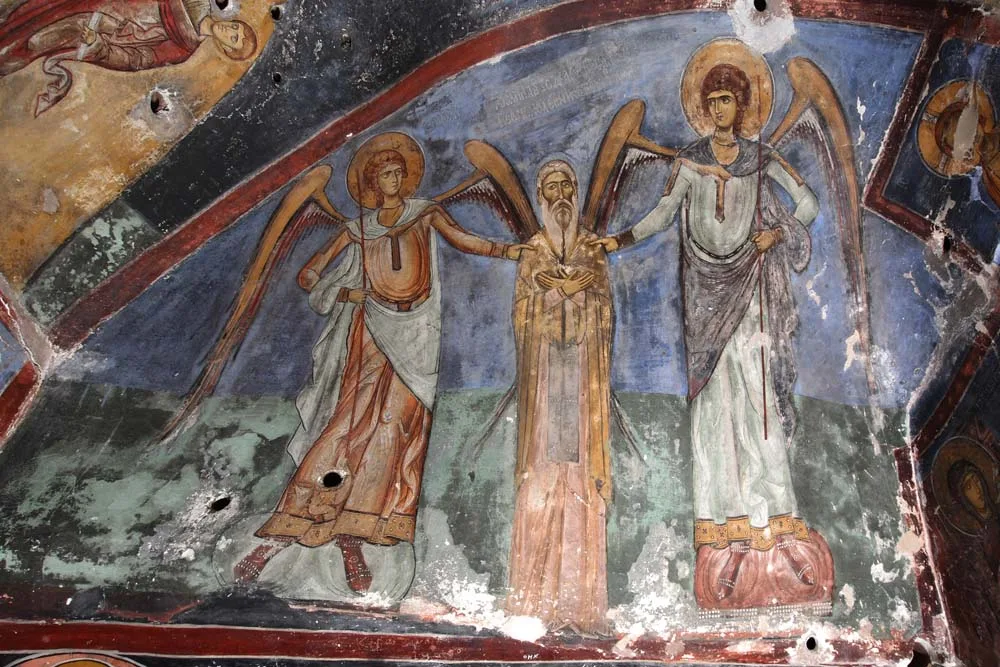
The cave was dug out by the saint himself and its decorative programme was also dictated by him, hence he acted both as a patron and curator. There are portraits of Saint Neophytos painted while he was alive, as well as posthumously.
The first phase of the frescoes was painted by the celebrated Constantinopolitan artist, Theodoros Apsevdis. It is extremely rare for artists of the Comnenian period (1081-1185) to be named, since Byzantine artists did not claim authorship of their creations. Instead, they perceived themselves as the means of divine manifestation.

The enkleistra included the cell in which Saint Neophytos dwelled, a chapel dedicated to the Holy Cross for prayer and, eventually, a chamber for his tomb, which he had prepared himself. The enkleistra is intrinsically bound to the Saint’s entire life - a testament of his earthly sojourn from the moment he arrived there until his death. This makes it important and relevant not merely to his homeland of Cyprus but to Orthodoxy at large and to the world’s collective cultural heritage.
Recreating St Neophytos’ enkleistra in 3D
The EUreka3D-XR project is in the process of recreating Saint Neophytos’ enkleistra as a virtual experience which will include the first-ever recording of the liturgy that is held on the Saint’s feast day and celebrated only twice a year.
Traducció al català
Sant Neòfit: El sant i el seu llegat
Qui va ser Sant Neòfit de Xipre i quins van ser els seus ensenyaments?
Sant Neòfit està representat entre els arcàngels Miquel i Gabriel, que el sostenen per les espatlles i les seves ales es creuen a l'esquena, donant la impressió que també és un àngel.
Sant Neòfit l'Ermità, també conegut com a Sant Neòfit de Xipre, va viure com a ermità i va deixar una vasta empremta teològica i cultural en la història de la seva pàtria i del món ortodox en general.
La vida de Sant Neòfit
Sant Neòfit va néixer el 1134 al poble de Kato Drys, prop de Lefkara, al districte de Larnaca, a Xipre. El seu nom de bateig era Neòfit, derivat de la paraula neòfit que significa “el recentment batejat”. Tot i que els monjos solen canviar el nom que tenien abans de la tonsura, Neòfit no ho va fer. Va conservar el nom que li van donar al baptisme, que estava carregat d'un important simbolisme religiós. En el seu escrit El Típic de l'Enkleistra, va esmentar que els seus pares eren pobres, d'origen rural i que ell era el més petit de vuit fills.
També va declarar que els seus pares esperaven que comencés a treballar en l'agricultura i que s'oposaven fermament al seu desig de convertir-se en monjo. Per tant, el seu primer intent d'unir-se a un monestir, concretament el de Sant Joan Crisòstom prop de Koutsoventis, va fracassar i va tornar amb la seva família.
El 1152, va aconseguir fugir al monestir de Kykkos, on va ser rebut com a novici i poc després va ser tonsurat com a monjo. Tanmateix, sentia que la vida al monestir era atrafegada i espiritualment distreient. Anhelava un estil d'ascetisme més aïllat, i per això va demanar permís a l'hegumen (cap d'un monestir masculí) per viatjar a Terra Santa, però la seva sol·licitud va ser denegada.
Posteriorment, a la recerca de la solitud que anhelava, va vagar per l'illa i finalment es va establir en una cova natural a Pafos, que estava destinada a convertir-se en la seva ermita.
Sant Neòfit va excavar més a fons la cova de roca existent i la va decorar amb frescos d'artistes hàbils segons la seva pròpia voluntat, incloent-hi retrats de la seva vida. Va ser allà on va viure la resta de la seva vida, allà on va escriure la seva substancial obra (aproximadament 30-40 escrits) i allà on va ser finalment enterrat quan va morir el 1214.
La cova pintada de Sant Neòfit —l'enkleistra, que literalment significa "lloc de clausura"— va formar el nucli d'una comunitat de deixebles que al segle XIII es va expandir i va donar lloc a la construcció del katholikhon (església amb baptisteri) i del monestir just al davant. El monestir s’ha mantingut fins als nostres dies i conserva les relíquies de Sant Neòfit i molts dels manuscrits que va escriure.
Quin és el llegat de Sant Neòfit?
Sant Neòfit va ser una figura cabdal del Xipre bizantí i després franc dels segles XII i principis del XIII. A través dels seus escrits, la seva enkleistra i els seus deixebles, Neòfit va deixar una vasta empremta intel·lectual, social, teològica i cultural en la història de Xipre.
Els seus escrits, incloent-hi el Typikon de l'Enkleistra , textos autobiogràfics, homilies i catequesis, epístoles, tractats i comentaris, així com admonicions per a la vida monàstica, són fonts originals i testimonis del món bizantí, que mostren com es veia i es jutjava des de Xipre, un lloc perifèric de l'imperi. Comenten la vida quotidiana dels xipriotes sota diferents governants i proporcionen informació de primera mà sobre les croades. Els seus textos sobre la vida monàstica van guiar altres monjos, van influir en les regles monàstiques i la formació institucional i ens proporcionen proves valuoses de com funcionaven les comunitats ortodoxes durant la seva època.
Per què és important l'enkleistra de Sant Neòfit?
L'enkleistra és un monument únic de l'art bizantí perquè combina una multitud de característiques, cadascuna de les quals és força única per si mateixa.
La cova va ser excavada pel mateix sant i el seu programa decoratiu també va ser dictat per ell, per la qual cosa va actuar com a mecenes i conservador. Hi ha retrats de Sant Neòfit pintats en vida, així com pòstumament.
La primera fase dels frescos va ser pintada pel cèlebre artista constantinopolità Theodoros Apsevdis. És extremadament estrany que s'anomenin els artistes del període Comnè (1081-1185), ja que els artistes bizantins no reivindicaven l'autoria de les seves creacions. En lloc d’això, es percebien a si mateixos com el mitjà de la manifestació divina.
L'enkleistra incloïa la cel·la on residia Sant Neòfit, una capella dedicada a la Santa Creu per a l'oració i, finalment, una cambra per a la seva tomba, que ell mateix havia preparat.
L'enkleistra està intrínsecament lligada a tota la vida del Sant: un testimoni del seu viatge terrenal des del moment en què hi va arribar fins a la seva mort. Això la fa important i rellevant no només per a la seva pàtria, Xipre, sinó també per a l'ortodòxia en general i per al patrimoni cultural col·lectiu del món.
Recreació de l'enkleistra de Sant Neòfit en 3D
El projecte EUreka3D-XR està recreant l'enkleistra de Sant Neòfit com una experiència virtual que inclourà la primera gravació de la litúrgia que se celebra el dia de la festa del sant i que només es fa dues vegades l'any.