
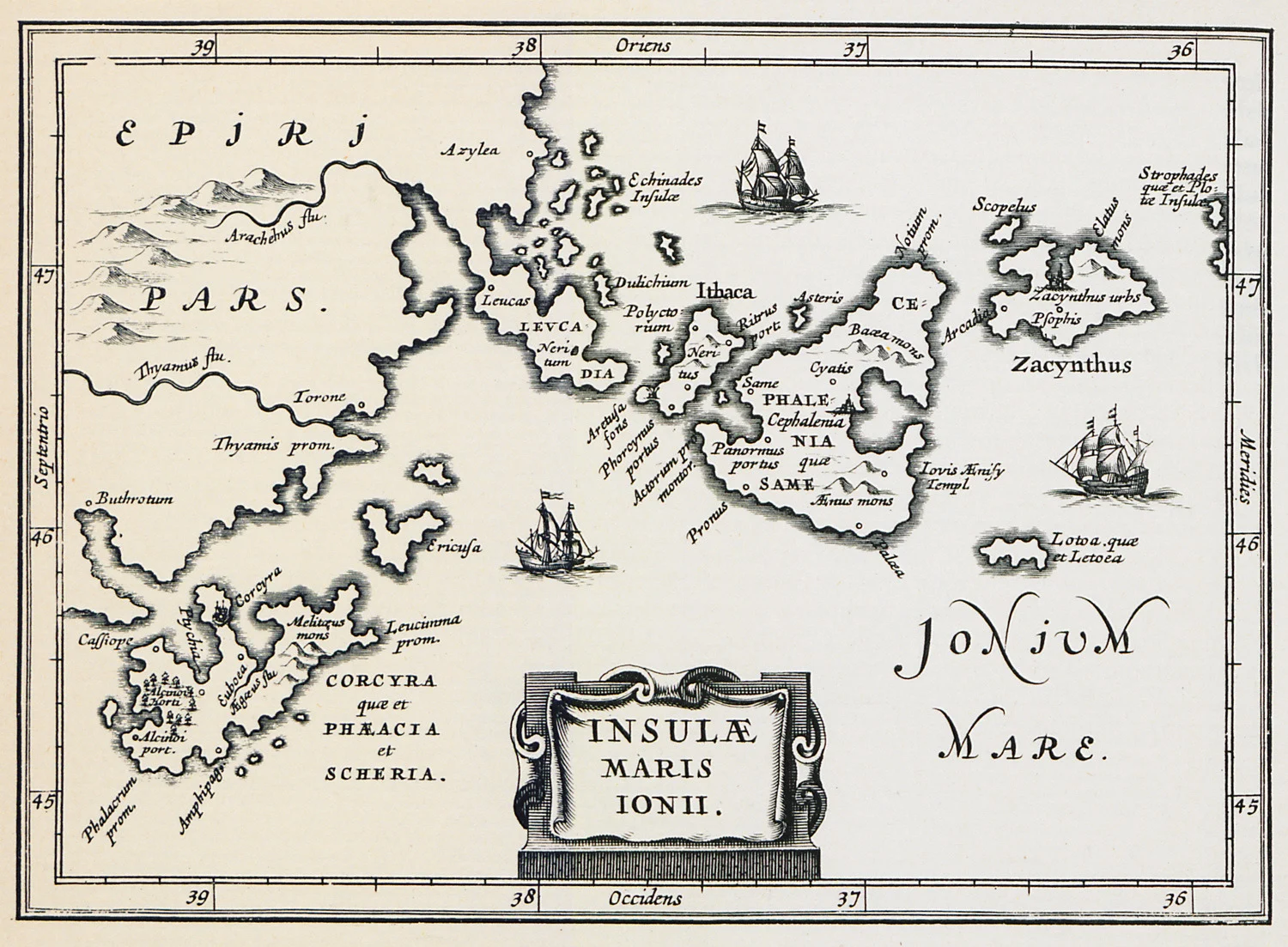
Many traditional recipes on the island of Corfu evolve around some variation of red sauce: a sauce that remains central while never quite the same. Here is the story of one family's red sauce.
Memory often surfaces through seemingly insignificant or unconscious triggers: the taste of a favourite childhood dish, tied to a place or a ritual — like the eggs in red sauce and the crispy fried potatoes my maternal grandmother, Kassiani, would make when we cycled home from the beach after a long day helping our aunt at her tourist canteen, one of the very first to be set up along the wide stretch of sand before the Korission Lagoon.

Her kitchen was a small, low-ceilinged, detached structure, shaded by tall olive trees beside the main road that cut through the olive grove — the one that embraced the Korission Lagoon. It was a modest space: stove, sink, a few old cupboards and cabinets, a table with four chairs, and a wooden couch where my grandfather would lie down for his afternoon nap.

From humble eggs in sauce (a local take on shakshuka) to rooster pastitsada (in which cinnamon and generous red wine lend a festive tone), and above all to bourdeto (one of the most beloved dishes of the locals), many traditional recipes on the island revolve around some variation of red sauce: a sauce that remains central while never quite the same. Tellingly, in Greek, 'to add sauce' is a metaphor for colouring the story. We’ll return to that red sauce in a moment.

Bourdeto traces its roots to the Venetian brodetto, a spiced fish stew with countless variations along the Adriatic coast. Born as fishermen’s fare, it used the low-value fish from the day’s catch and is as closely related to Marseille bouillabaisse as it is to Greek kakavia. Brodetto has taken as many forms as there are villages, each using whatever fish is locally abundant. Around the Adriatic you’ll find numerous brodetti: Ancona sits at the centre, while north of the city, versions traditionally call for thirteen types of fish, and to the south they use nine. Most recipes include tomatoes, though some feature saffron, green peppers, or peperoncini instead.
According to the Accademia del Brodetto in Porto Recanati — an association of restaurateurs dedicated to preserving the 'original' recipe — a classic brodetto (as codified in the 19th century by chef Giovanni Veluticini, who served it and even canned it for sale across Italy) is made strictly with saffron. Yet what reads like canon on the Adriatic is largely ignored further south: the Ionian bourdeto follows its own logic and hosts its own internal variations. Before returning to how my paternal and maternal grandmothers cooked it respectively in central and southern Corfu, it’s worth noting what seems indispensable in these Corfiot versions: sweet and spicy paprikas.

While pepper entered Venetian cuisine early - merchants such as Romano Mairano were bringing it from Saladin’s Alexandria as early as 1173 - tomatoes and paprika did not arrive from the New World until the 16th century. For centuries, Corfu was a key outpost of Venice’s Stato da Mar (sometimes called the cuore dello Stato) and absorbed much of the metropolis’s culture. Given Veluticini’s 19th-century 'original' claim and the Venetian Republic’s end in 1797, if Corfu inherited bourdeto from Venice, the dish surely predates his later codification. This, in turn, suggests Veluticini’s 'purist' version, made solely with saffron and which, although it is nearly a national fruit in Italy, excludes tomato, formalised a long-standing regional method for cooking fish and seafood in spices. Perhaps this is why tomato occupies an ambiguous place in Corfiot bourdeto: when I mentioned using it to friends in northern Corfu, some replied, 'That’s not bourdeto.' Others were more relaxed; one local chef shrugged, 'Add tomato paste if you like.' It may sound like a small tweak, but it changes the dish’s character.
My maternal grandmother, Kassiani, was from the south and cooked with whatever the Korission Lagoon and nearby sea offered: scorpionfish, all sorts of fatty rockfish (whose bones yield a deeper broth than their flesh), grey mullet, prized eels, even the intimidating moray eel, the occasional dogfish, and sometimes octopus. For the sauce she would occasionally add fresh tomatoes, but its vivid red came chiefly from sweet paprika. That almost Apollonian single-spice clarity drew out the richness of the fatty fish, which in turn called for a balancing local wine — an amber-toned rosé called Petrokoritho (local rosé).

Yet both the sauce and the fish were also a metonym for community and for how communities differ. My paternal grandmother, Maria, had her own way. She grew up in the foothill village of Agios Matthaios, where olive cultivation was the main work and fishing or hunting played a smaller role (though a few families lived almost entirely off the lagoon and sold their catch in the village). That setting produced a version of bourdeto made with what was at hand: typically dried salt cod from the village grocery, the bakaliko (the same fish used in Greece’s beloved batter), fried salt cod with skordalia - a garlic–potato purée traditionally eaten on 25 March (Independence Day). The distinctive smell of dried fish mingling with the soapy scent of detergent powders and paraffin oil was once the standard aroma of a Greek grocery, many of which doubled as cafés (kafeneio-pantopoleio). Pair that cod with another staple from the same shelf, canned tomato paste, and the tomato’s tang becomes the perfect counterweight to the fish’s saltiness. Like the southern version, it, too, asked for a generous pour of Petrokoritho (local rosé), or even the strongly aromatic Kakotrygis (aromatic local white), alongside.

So which bourdeto is the 'right' or 'original' one? I think that’s the wrong question. Bourdeto is a method - a way of turning what a place gives into culture through cooking — so it forms a spectrum, even a constellation, rather than a single canon. The method, however, is always anchored to the dish’s core: the fish, itself an expression of the environment — the topos. As for which I prefer, that’s another matter. Whether I’m drawn to the playful ingenuity born of scarcity, or to the place-bound richness of fatty fish as an expression of the land’s fertility - it’s a hard choice, and I haven’t made up my mind. If 'sauce' becomes a metaphor for narration — even for exaggeration — then these sauces, in their communal origins, are the ways communities tell their stories.
References
Accademia del Brodetto di Porto Recanati — La Storia.
Emory ScholarBlogs — History of the Tomato in Italy and China: Tracing the Role of Tomatoes in Italian and Chinese Cooking.
McCormick Science Institute — Paprika.
Smithsonian Magazine — The Spice Trade: Pepper & Venice, (Jack Turner).
Gourmet Traveller — Brodetto.
Gastronomos — Octopus Bourdeto.
TasteAtlas — Bourdeto.