
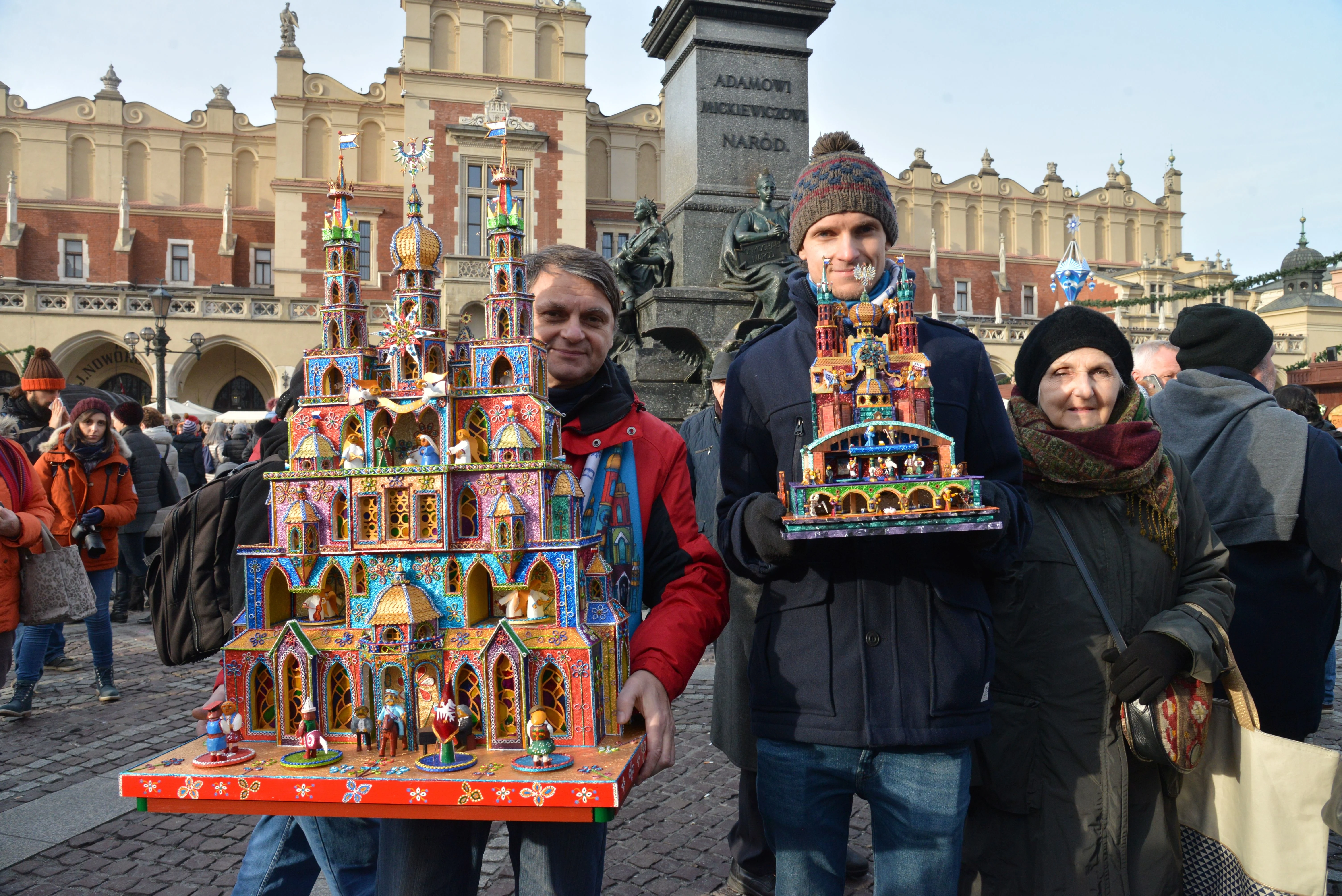
In Kraków, Poland, making nativity scenes is seen as a cultural tradition going back centuries.
Every Christmas in the Polish city Kraków, skilled craftspeople compete to create nativity scenes, part of a cultural tradition going back centuries. Let's explore the people behind the tradition, and meet the Malik family of artisans who have turned nativity scenes into an expression of local pride and creativity.
What are nativity scenes?
A nativity scene is a traditionally Christian display of the birth of Jesus. It often shows a manger with baby Jesus, surrounded by Mary and Joseph, barn animals, shepherds and the three wise men that come and bring gifts to the newborn prophet. Nativity scenes come in all shapes and sizes: they might be life-sized, using actors to represent the protagonists, or they might be small wooden scenes made to display in homes.


Nativity scenes in Kraków
In Kraków, making nativity scenes is seen as a cultural tradition going back centuries. The Kraków nativity scene, as a cultural phenomenon, was added to the UNESCO World Heritage List in 2014. The scenes created there contain selected fragments of Krakow's architecture, in which people associated with Christmas are placed, as well as fictitious characters from legends.

This tradition was initiated by bricklayers who sometimes could not do their work erecting buildings when the weather was too bad. This was especially true in autumn and winter. So they started to create small substitute buildings instead, like nativity scenes, that they could sell at local markets. They also created large moving cribs, which acted as a puppet show of sorts with which they carolled around homes to get some income during their unemployment.

In 1937, the director of the Historical Museum of the City of Kraków, began to organise competitions for the most beautiful Kraków nativity scenes. In 2022, the 80th edition of the competition took place. The results of the competition are always solemnly presented in the city, in front of the monument to the national poet Adam Mickiewicz.
Those taking part in the competition create their nativity scenes for many months, reproducing Kraków's rich architecture in detail. Their nativity scenes are a stylistic mix, a product of the creator's imagination.
Meet the Malik family
The Malik family from Kraków's Zwierzyniec district are the best example of cultivating this tradition. They have been participating in this phenomenal project for four generations, winning numerous awards.
The family's nativity scenes tradition was initiated by grandfather Walenty, cultivated by his son Włodzimierz, his grandson Stanisław and now continued by his great-grandson Andrzej.
Stanisław Malik
Stanisław Malik received the Honoris Gratia medal in 2022 for numerous award-winning works that he has been creating since 1978. His nativity scenes have won prizes in more than 27 competitions. In 2018, Stanisław received one of his most treasured prizes: the honorary 'Meritorious for Polish Culture' badge awarded by Poland's Minister of Culture.
His works can be found in many Polish museums, as well as in foreign institutions and private collections.
One of the most common motifs Stanisław incorporates in his nativity scenes is the churches of Kraków: the soaring towers of Saint Mary's Church or the golden domes of the Sigismund Chapel in the Wawel Cathedral. His nativity scenes are made of wood, cardboard and tin foil. They sparkle with numerous colours, among which the dominant colour is the red of the Gothic bricks of Krakow's buildings.

Włodzimierz Malik
Stanisław's father, Włodzimierz Malik (1912-1990), became interested in creating nativity scenes at the age of 4, watching his father work.
The 16th-century nobleman Twardowski is often present in Włodzimierz's nativity scenes, along with the Holy Family. According to the legend, Twardowski was the first Pole on the moon. He sold his soul to the devil in exchange for wisdom. When he tried to trick the devil, he was kicked to hell but ended up on the moon.
Włodzimierz's nativity scenes were also awarded numerous times. In 1959, he received a gold badge from the Presidium of the National Council of the City of Kraków, awarded 'For social work for the city of Kraków'.
Walenty Malik
Walenty Malik, Stanisław's grandfather, was the first nativity scene maker in the family. He created large nativity scenes, often more than two metres high. His works were put on display in parishes, and at the Kraków Industrial Museum. He even lugged these scenes around to go carolling!

Andrzej Malik
Andrzej Malik made his first nativity scene at the age of 10. Born in 1990, he's the youngest in the family. Andrzej specialises in smaller nativity scenes, but he also does not avoid larger installations.
He mostly plays with Gothic architecture, and is also inspired by the works of the artist of the Secession period, Stanisław Wyspiański (1869-1907). Especially Wyspiański's stained glass windows fascinate him.
In 2020, Andrzej Malik received the Creative Scholarship of the City of Kraków. He has also run workshops for creating nativity scenes for children in Frankfurt and Orléans.
This blog was written as part of the CRAFTED project, which aimed to enrich and promote traditional and contemporary crafts.