
What is the symbolism of food in fairytales and folklore?

Why are so many fairy tales about hunger?
Fairy tales were originally spoken stories about folklore and culture in Europe, passed down from one generation to another. They have always dealt with some of the darker elements and cautionary tales relating to the human condition - including poverty, violence and hunger.
Fairy tales started to be written down during the Renaissance, a period of time associated with a strengthening interest in culture, literature and human potential. The Renaissance began around the start of the 1300s, and during this time, there was another significant event - the Great Famine of Europe (1315-1317) - which marked the end of a previous period of population growth and prosperity. Crop failures caused by a ‘Little Ice Age’ led to a sudden lack of food and 5-12% of the population of northern Europe died. So it is no surprise that hunger might be prominent in stories from around this time.
Another factor could be that the Grimm brothers, who wrote down (and re-wrote) many of these fairy tales in the early 1800s, were no strangers to hunger themselves - after both their parents died, the brothers deprived themselves of food to make sure their younger siblings could eat.
Hunger can be used metaphorically too, symbolising a longing - or hunger - not just for food but for a different life, or different loves.
Surmounting the insurmountable - challenge and test
Sometimes, food is used to symbolise challenge and test. In Hans Christian Andersen's The Princess and the Pea, the Princess bears the discomfort of the pea to prove that although she doesn’t look like a princess, having battled through a storm to arrive bedraggled at the prince’s door, she has the sensitive soul of one and so can marry the prince.

Jack’s magic beans represent a test of faith - to be hungry and swap your only cow for five beans based on nothing but a promise makes you either foolhardy or faithful.
Be careful what you wish for - longing for children
Momotarō (Japan), Tatterhood (Norway) and The Juniper Tree (Germany) are examples of stories in which a mother who longs for children eats something that brings about the much-anticipated infants.
In Tatterhood, a Queen is instructed to eat one of a pair of flowers in order to have a child. She should eat only the beautiful flower, but consumes both the ugly and beautiful one and so receives two daughters, one beautiful, one ugly.
In Momotarō, a couple spot a giant peach and eat it, revealing a child hidden inside that they raise as their own. Later, Momotarō enlists the help of a dog, a monkey and a pheasant in his quest to vanquish some ogres, and pays for their support in dumplings (kibi dango).

In The Juniper Tree, a woman cuts her finger peeling an apple and wishes for a child, who duly arrives, but the mother dies from eating juniper berries. The child’s new stepmother treats him very badly and ends up killing him, cooking him and serving him to his father. All ends well though as the stepmother is killed by a stone dropped by a bird who turns out to be the stepson and the family is reunited.

Sometimes however, children pose a problem and food is used to try to get rid of them. The seemingly perfect apple offered to Snow White is intended to kill her to avenge the evil Queen’s jealousy.

Fee-fi-fo-fum - escaping consumption
Food in fairy tales allows for some rather dark themes to be explored, with the central characters becoming not the consumers but the consumed.
Tom Thumb is accidentally baked into a pudding, and is later swallowed by a cow, and then by a giant, then by a fish. Miraculously, he escapes them all. Jack outwits the giant at the top of the beanstalk who wants to grind his bones to make his bread. It is a lack of food that drives Hansel and Gretel’s parents to make the heartbreaking decision to ‘lose’ their children in the woods, and a gingerbread house that seduces them but is, of course, a trap set by a witch so she can eat them.

Then there are the animals - the big bad wolf who eats Little Red Riding Hood’s grandmother, or the other big bad wolf who wants to eat the Three Little Pigs.

Not to mention the fox who wants to eat the Gingerbread Man, or the other fox who eats all the animals except Chicken Licken. In each instance, the villain is outsmarted and a moral lesson is learned - perhaps the most important being be careful who you trust and don’t believe everything you hear.

Further reading
- Why all fairy tales are about hunger, Snowwhitewrites.com
- Grimm stories of food, William House, BHMA.org
- The great famine, Science.smith.edu
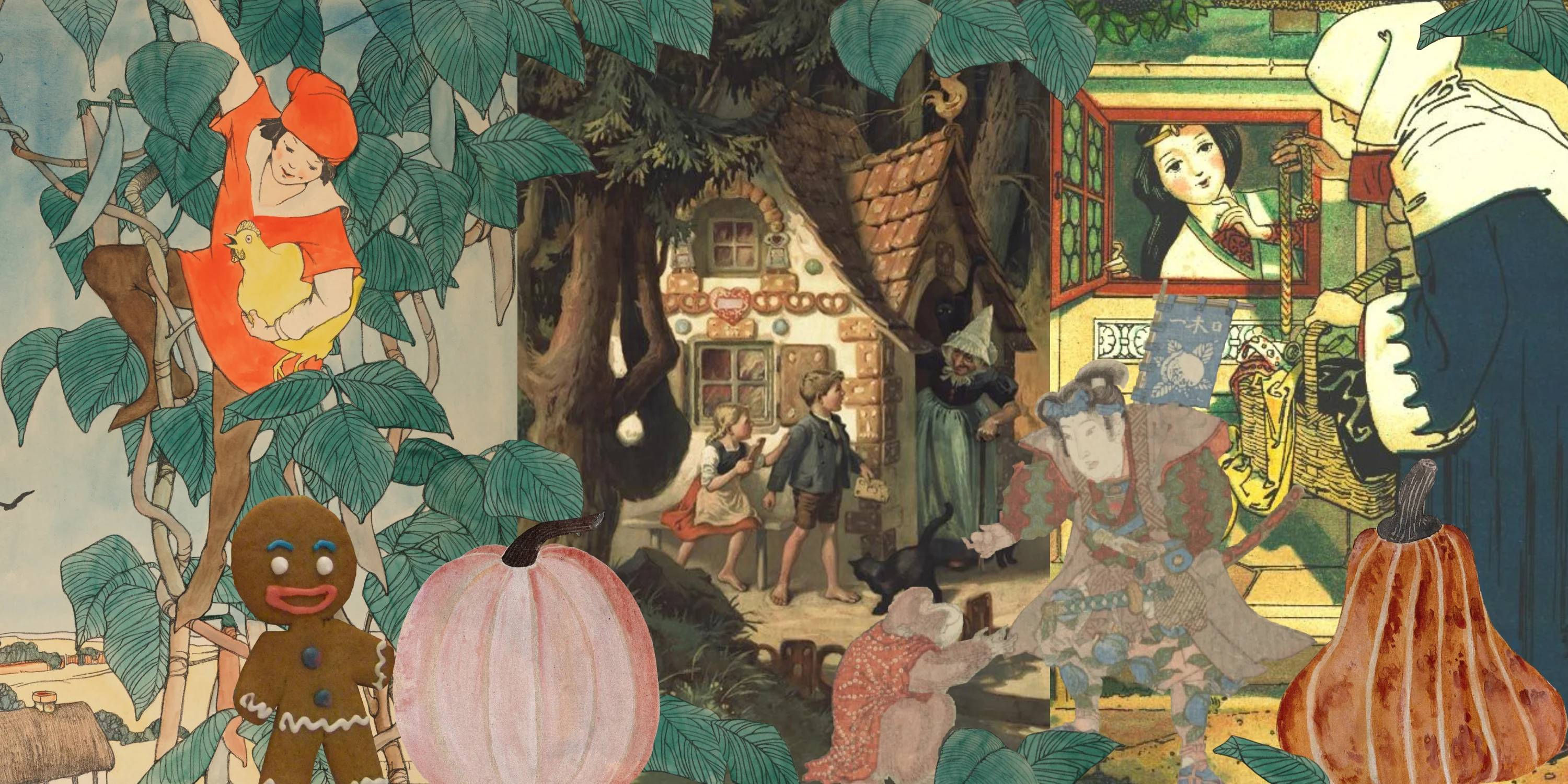
Credits for food and fairytale collage
- Gingerbread landscape, Wikimedia, CC BY-SA
- Jack and the beanstalk, Elisabeth Taylor, Wikimedia, Public Domain
- Snow White, Franz Jüttner, Wikimedia, Public Domain
- Japanese pumpkin (Cucurbita moschata): rounded fruit. Watercolour, Wellcome Collection, CC BY
- Japanese pumpkin (Cucurbita moschata): tear-drop shaped fruit. Watercolour, Wellcome Collection, CC BY
- Momotarō handing millet balls to monkey, Chester Beatty Library, CC BY

.jpg)
