
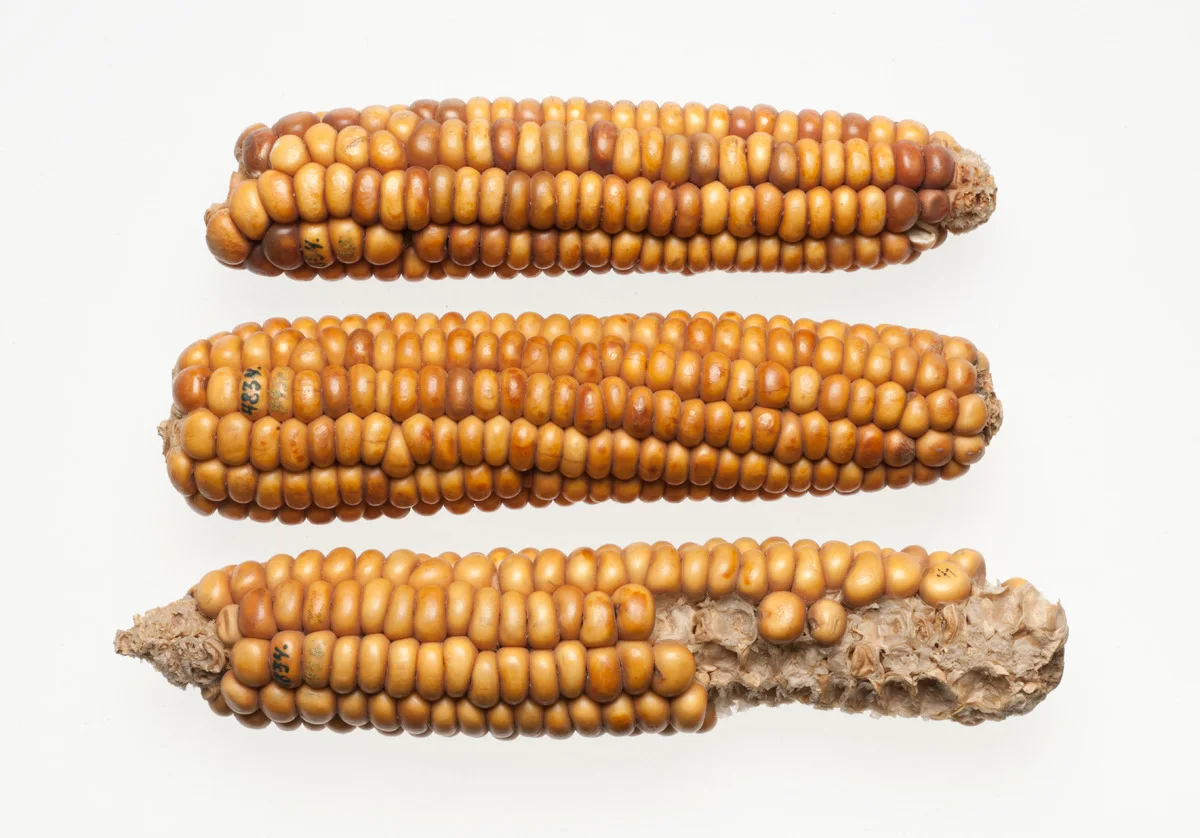
What is the historical, biological, economic and cultural significance of corn?
The history of corn and its domestication closely mirrors human progress and cultural development. As a significant agricultural achievement, corn still holds secrets and offers new opportunities.
What is corn/maize?
Modern cultivated corn (or maize) is an annual plant that can grow up to 3 metres tall. It has both male and female flowers, and each plant produces a maximum of two fully formed cobs. Its scientific name is Zea mays. Zea simply means 'spelt', and mays comes from the Spanish 'maíz', which in turn developed from the indigenous name 'mahiz'.

Although corn originated in Central America and Mexico, it now grows widely across subtropical and temperate regions, with about 5,000 different varieties. The plant has adapted to different climates through selective breeding.
Corn's European journey started as an ornamental plant, followed by its use as animal feed. From the 19th century onwards, with the emergence of sweetcorn, it became a staple food for poorer sections of the population. Today, industrial nations use corn primarily for animal feed and as a source of energy (biofuel and biogas).

How did the plant evolve?
Geneticists and archaeologists have determined that modern corn evolved around 9,000 years ago from its predecessor in the tropical lowlands of what is now southern Mexico. Its wild ancestor, an inconspicuous wild grass called teosinte, is native to Central America. The relationship between the two plants is now considered almost certain: their flowers are quite indistinguishable, they have the same number of chromosomes, and they can still be bred without any problems.

However, corn and teosinte differ in appearance. Corn features thick cobs with many rows of kernels, while teosinte has shorter fruits with only six to nine small kernels in a few rows.
The archetypal species from which modern corn developed still exists and can be found in Mexico and Guatemala. These include Zea mays subespecies parviglumis and Zea mays subespecies mexicana. The former has made a greater contribution to today's species.

A 2018 study revisited the history of corn domestication by examining the spread of individual lines in South America and the associated genetic changes using genome analyses. The scientists discovered that domestication did not originate from one location, but from at least two.
Old landraces from Central and South America also offer potential for future breeding programmes. In 2017, a team of scientists analysed 4,500 landraces and identified more than 1,000 genes that influence preferred growing locations. This opens up opportunities for adapting corn to changing environmental conditions.

How did corn spread around the world?
Over a long period, domesticated corn spread throughout the Americas until the arrival of Europeans in Central and South America at the beginning of the modern era.
Christopher Columbus brought the first corn kernels back to Spain on his second expedition in 1496, marking the beginning of the plant's success in Europe. From there, it spread throughout the Mediterranean region and on to Turkey, where it was known as 'Turkish grain' due to its intensive cultivation.
Corn greatly improved nutrition for impoverished populations. Thriving in warm regions, it filled supply gaps with summer harvests. In the north, corn remained uncultivated until the mid-20th century, when a more cold-hardy variety appeared.

What about the cultural significance of maize?
In its original homeland, corn played an important role in the indigenous population's myths and religious practices. They believed that corn was a gift from the gods. Various corn deities were worshipped in the form of statues, images and offerings. According to the creation myth of the Mayans and Aztecs, the gods formed humans from corn.

It is believed that corn was fundamental to the development of advanced civilisations in Central America because it provided people with a reliable food source.


The earliest known depiction of corn in European culture is attributed to the Spaniard Burgmair, who illustrated the Revelation of Saint John the Apostle on the island of Patmos in 1518, featuring two corn plants. Since then, corn has been depicted repeatedly, often as a symbol of fertility, as in Arcimboldo's 1591 painting below.

In 1542, the corn plant was depicted for the first time in a botanical book about the use, origin, and healing properties of plants, the New Kreüterbuch (New Herbal Book) by Leonhart Fuchs. Here, corn was still referred to as 'Turkish grain', as its actual origin had apparently been forgotten.

What are the benefits of genetic diversity in corn?
Corn ranks among the world’s oldest and most vital crops. Scientists deciphered its genome in 2009, revealing 32,000 genes - more than humans. 85% were categorised as transposons, mobile DNA elements that drive mutations and adaptation to environmental shifts.
Her theory was ridiculed by other scientists for a long time, but was finally confirmed thanks to improved molecular techniques in the 1970s and 1980s.

Although the initial discovery was considered an isolated case, it eventually became clear that transposons are present in all organisms. In humans, for instance, they account for half of the genome.

More than 30 years later, in 1983, Barbara McClintock received the Nobel Prize in Physiology or Medicine for her discovery of ‘jumping genes’. She was only the third woman to receive an unshared Nobel Prize in the field of natural sciences.

What is the economic significance of corn today?
Humans have cultivated corn for thousands of years to adapt it to different climatic conditions. This has led to several varieties being developed, which now account for a large proportion of global corn production.
One example is hard dent corn, which is ground without water and processed into products such as cornflakes, polenta, biscuits and snacks, as well as animal feed. Sweetcorn is usually eaten as is, either on the cob or off. As the sugar is not converted into starch, it tastes sweet. In contrast, starch corn has long been the main source of food in South and Central America, and is used to produce corn starch for industrial food production.
Although corn contains numerous minerals and vitamins, it can lead to deficiency when consumed in an unbalanced diet due to its lack of essential amino acids.

How will corn develop in times of climate change?
After wheat and ahead of rice, corn is one of the most important crops. It is one of the five to seven plants that feed the entire world, although most corn varieties are grown to produce animal feed (silage) and energy (biogas).
Climate change is constantly altering the conditions for agricultural cultivation. Extreme weather events such as droughts and floods are one reason, as are pest infestations by highly adaptable insects. New strategies must also be found to combat neophytes (non-native plants and animals).
There are high hopes in the scientific community for adapting plants through breeding. Specific traits, such as drought resistance, stability, and quality can be promoted. This is where the diverse corn genome, which has a high proportion of transposons, comes into play. This fact holds great potential for preparing current corn varieties for a changing climate.
