
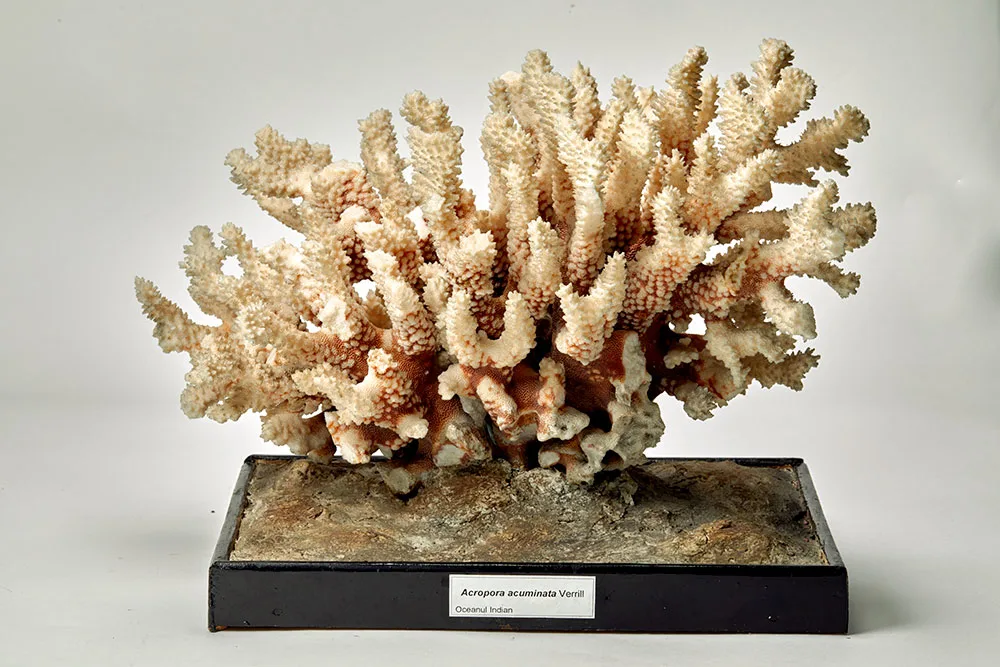
Corals have always held a special fascination for people, due to its unique growth pattern, its connection to mythology and its importance to coastal ecosystems.
How are corals structured?
For many years, people assumed that corals were plants due to their growth form and their polyps, which are often flower-shaped. They were once also considered to be part of the stone and mineral kingdom. In 1723, French naturalist Jean André Peyssonel was the first to suggest that they belonged to the animal kingdom, for which he was ridiculed.

Corals are found exclusively in the sea and, like jellyfish and sea anemones, belong to the cnidarians (aquatic invertebrates found both in freshwater and marine environments). They are divided into different cnidarian groups that are not further related to each other. In terms of their growth form, a distinction is made between stony and soft corals, with the former being mainly responsible for the formation of coral reefs. Calcium deposits produced by the animals' metabolism form skeletons that run through the entire colony and serve as its support structure.

The colony itself consists of numerous small creatures called polyps, which settle near coastlines with the sea current. Although corals are depositing calcium constantly, the formation of coral reefs can take centuries or even millennia. They are one of the most important habitats in the sea and are home to the greatest maritime biodiversity.

How do nutrition and reproduction work in corals?
Corals filter their food, which consists of microplankton, nutrients and trace elements, from seawater. However, this alone is not enough for many species, and they need an additional source of food.
This is where an ingenious relationship comes into play, ensuring the survival of the corals. Algae called zooxanthellae typically colonise the outer skin of the polyps, forming a symbiotic relationship with the coral. Both life forms benefit from each other's metabolic products. The polyps excrete carbon dioxide and the algae use it to produce oxygen and glucose through photosynthesis, which in turn benefits the coral. Therefore, it is important that the algae always receive enough sunlight to enable this process. The algae are also responsible for the characteristic colouring of the corals.

Coral can reproduce both sexually and asexually. Even within a colony, there are male and female polyps, which is why they are referred to as hermaphrodites. These polyps release their gametes into the environment. Fertilisation can take place either in open water or within the colony by a female polyp that broods its offspring. This produces a planula larva, which can drift around in the sea for some time before settling on the seafloor or a rock. If conditions are favourable, a new colony will form.

In asexual reproduction, the coral reproduces by distributing fragments that can form colonies in other locations, similar to cuttings in the agricultural field.
What significance do coral reefs have for humans?
The biodiversity of coral reefs and their relative proximity to the coast have always provided humans with a wealth of usable resources. Fish, crustaceans and shellfish serve as food, and dead coral reefs can be used as building material. Coral reefs also protect shores from incoming waves during tropical storms.
Furthermore, the beauty of the reefs attracts numerous tourists, boosting the local economy.

Coral reefs also play an important role in medicine and biotechnology. Certain substances extracted from them can be used to treat diseases such as leukaemia, arthritis and skin cancer.
Furthermore, corals and their derivatives have historically played a significant role in human history and everyday cultures. Coral jewellery has been incorporated into costumes, traditional attire and shrines in both religious and secular contexts, thereby acquiring a symbolic character.

How is coral exploited commercially today?
Harvesting coral always required a special relationship between humans and the sea. Lifting these marine animals from the seabed was a dangerous undertaking. While the corals in the Mediterranean are not directly threatened with extinction, environmental issues mean that harvesting is now subject to strict regulations.
Today, there is a strict EU-wide ban on harvesting with dredging equipment, which can cause significant physical damage to reefs. In addition, attempts are being made to completely restrict mining in marine protected areas.

What significance do corals have for art and culture?
Coral, both as an object and a symbol, is deeply rooted in the mythology and history of Mediterranean cultures.
Even in prehistoric times and antiquity, it was traded as a precious commodity by the Egyptians, Romans and Greeks and sold as jewellery to neighbouring countries. According to legend, coral was created from the frozen blood of Medusa that flowed from her severed head. In history, coral was therefore considered a symbol of strength and protection. The Greeks and Romans used it as a remedy for a wide variety of illnesses.

Remains of red coral have also been found in prehistoric Central European graves, suggesting that it was used as jewellery and protective amulets and was actively traded.

Red-coloured plants have been highly prized since prehistoric times due to their rarity, and eventually found their way into the canon of Christian symbolism in the Middle Ages. The colour red was intended to represent the Passion of Christ. Additionally, the protective symbolism of antiquity was revived, with coral being depicted as having protective and healing properties and being considered an amulet against the 'evil eye'.

When cabinets of curiosities became increasingly popular during the Renaissance and Baroque periods, coral and objects made from it gained a whole new significance as collector's items. The modern cabinets of curiosities were mostly set up by nobles and wealthy citizens and are considered the precursors of today's museums. The oldest and largest collection of coral has been preserved in the collection of Archduke Ferdinand II in Ambras Castle in Innsbruck.
The coral was either collected as unprocessed branches, cut into figures, integrated into larger works of art or used for scenes in coral cabinets (dioramas).


How seriously are coral reefs threatened with extinction?
Coral reefs are under threat from various factors, including ocean acidification and pollution, overfishing, and the consequences of climate change. Climate change poses a particularly serious threat to corals. According to a 2021 report by the Intergovernmental Panel on Climate Change (IPCC), an increase in global temperatures of 2°C will most likely result in the disappearance of 99% of all coral reefs.
Ocean acidification makes it harder for corals to extract the calcium carbonate they need to build their skeletons, ultimately reducing their resilience. However, it is the warming of the oceans in particular that is fuelling fears of a tipping point for these fragile ecosystems.
When the water temperature rises above 30°C, corals expel their algae partners. What remains are white calcium skeletons. This process is called 'coral bleaching' and is reversible as long as the temperature drops again. If it remains elevated for too long, however, the corals die due to the disappearance of their most important food source.

In addition to climate change, certain aspects of the human lifestyle also have a direct impact on coral populations. For example, overfishing disrupts the natural balance between herbivores and carnivores and can cause physical damage through aggressive fishing practices.
What are global tipping points?
In the early 2000s, the world's coral reefs were identified as one of numerous global tipping points. Tipping points are critical thresholds which, when exceeded, lead to significant and often irreversible changes in a system. Exceeding tipping points through various influences such as rising temperatures can lead to a cascade of interrelated changes on Earth. The effects of these changing systems cannot be definitively assessed and may only manifest themselves after hundreds or thousands of years.
Thanks to significant scientific advances in recent years, we now know that global tipping points will be reached much faster than previously thought. Even with an increase in global temperature of (only) 1.5°C, the first tipping points will be exceeded. This includes the collapse of the Antarctic and Greenland ice sheets, the thawing of permafrost regions, and the death of coral reefs.
For this reason, it is essential for the preservation of our coral reefs to limit global temperature rise to below 2°C in accordance with the Paris Agreement on Climate Change. With falling temperatures, coral colonies could recover from their bleaching.